
Thermodynamics | Vision Academy
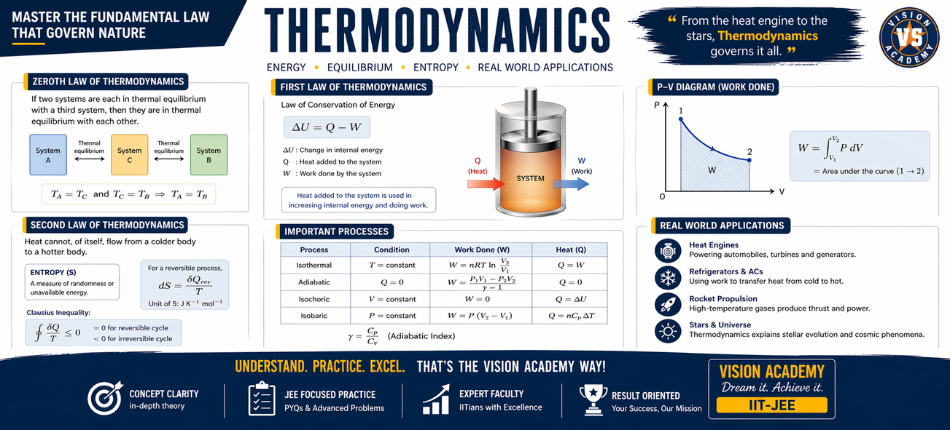
Master Thermodynamics Numericals & Concepts | IIT – JEE Coaching – Vision Academy
Introduction
Thermodynamics is not just theory—it is a scoring chapter when you master numericals. Many students struggle due to lack of conceptual clarity and practice. This guide by Vision Academy will help you crack Thermodynamics easily.
Why Students Find Thermodynamics Difficult
Thermodynamics is often considered a challenging topic because it combines both conceptual understanding and mathematical application. Many students struggle to clearly differentiate between heat, work, and internal energy, which are fundamental to the chapter. Additionally, multiple processes like isothermal, adiabatic, isobaric, and isochoric require different formulas and conditions, making it confusing to apply the right approach in numericals. Another major difficulty is sign convention and unit handling, where small mistakes can lead to incorrect answers. Without proper conceptual clarity and consistent practice, students tend to memorize formulas instead of understanding their derivations, which creates problems in solving application-based questions in exams like JEE and NEET.
Step-by-Step Strategy to Master Thermodynamics
Step 1: Understand Basic Concepts
Build a strong foundation by clearly understanding heat, work, internal energy, and temperature relationships.
Focus on concepts instead of memorizing formulas so you can apply them correctly in numericals.
Step 2: Learn Important Processes
Study key thermodynamic processes like isothermal, adiabatic, isobaric, and isochoric with their conditions.
Understand when and how to apply each process and its formula in problem-solving situations.
Most Important Formulas to Remember
- Isothermal Work: W = nRT ln(V₂/V₁)
- Adiabatic Relation: PV^γ = constant
- Efficiency of Engine: η = W/Q₁
Tips to Solve Numericals Faster
To solve thermodynamics numericals quickly and accurately, students must first develop a habit of writing all given data and identifying what is required before starting the solution. Understanding the concept behind the question is more important than directly applying formulas. Always choose the correct formula based on the type of thermodynamic process involved. Maintaining proper units (SI units) and following the correct sign convention for heat and work is crucial to avoid mistakes. Regular practice of previous year questions and mock tests helps improve speed and accuracy. Breaking complex problems into smaller steps and revising important formulas daily can significantly boost confidence and performance in exams.
Real-Life Applications of Thermodynamics
Thermodynamics is not just limited to textbooks—it plays a vital role in our daily life and modern technology. Common appliances like refrigerators and air conditioners work on thermodynamic principles to transfer heat and maintain temperature. Automobiles use internal combustion engines that convert heat energy into mechanical work. Power plants generate electricity using thermodynamic cycles such as steam turbines. Even the human body follows thermodynamic laws by converting food into energy for survival. Understanding these real-life applications makes the subject more interesting and helps students relate theoretical concepts to practical situations, improving retention and comprehension.
Best Study Plan for Thermodynamics
An effective study plan is essential to master thermodynamics. Students should begin by building strong conceptual clarity through NCERT and basic theory, followed by solving simple numerical problems. A daily routine of at least 2–3 hours dedicated to this chapter is recommended, dividing time between concept learning, problem-solving, and revision. Weekly tests should be included to evaluate progress and identify weak areas. Creating short notes of formulas and important concepts helps in quick revision before exams. Consistency is key—regular practice and timely revision can make even complex topics easier and improve overall exam performance.
How Vision Academy Ensures Success
Vision Academy provides a structured and result-oriented approach to mastering thermodynamics. The academy focuses on building strong fundamentals through experienced faculty and simplified teaching methods. Students receive well-planned study material, regular assignments, and chapter-wise tests to ensure continuous improvement. Special doubt-solving sessions and one-on-one guidance help students overcome their weak areas effectively. With exam-oriented strategies, shortcut techniques, and consistent motivation, Vision Academy ensures that students not only understand thermodynamics but also score high in competitive exams like JEE, NEET, and board exams.
Conclusion
Thermodynamics is a high-scoring chapter if prepared correctly. With the right strategy and expert guidance from Vision Academy, you can easily master both concepts and numericals.
 Previous Post
 Next Post