
Organic Chemistry Study Tips
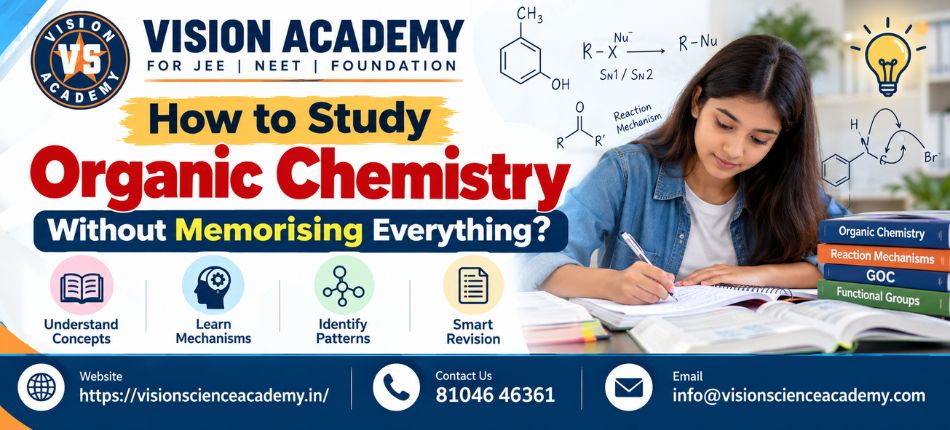
Organic Chemistry Study Tips: Learn Without Memorising Everything- Vision Academy
Organic Chemistry often feels difficult because students try to remember hundreds of reactions, reagents, conversions, and exceptions separately. This approach can quickly become confusing, especially while preparing for competitive exams such as JEE and NEET.
The better approach is to understand the logic behind Organic Chemistry. Once you develop a strong foundation in concepts such as electronic effects, reaction mechanisms, intermediates, nucleophiles, electrophiles, and functional groups, many reactions begin to follow recognizable patterns.
If you are wondering how to study Organic Chemistry without memorising everything, the key is to shift from reaction-by-reaction memorisation to concept-based learning, regular practice, and systematic revision.
At Vision Academy, students preparing for JEE and NEET are encouraged to understand why a reaction occurs instead of simply remembering the final product.
Why Does Organic Chemistry Feel Difficult?
Organic Chemistry can initially seem like a subject filled with unrelated reactions. Students encounter different compounds, reagents, mechanisms, products, and exceptions, which can make the syllabus appear overwhelming.
The difficulty often increases when students begin memorising individual reactions without understanding the underlying concepts. As the syllabus grows, similar-looking reactions can easily get mixed up.
Organic Chemistry becomes more manageable when topics are studied in a logical sequence and new reactions are connected with concepts already learned.
1. Build a Strong Foundation in General Organic Chemistry (GOC)
General Organic Chemistry (GOC) forms the foundation for understanding most Organic Chemistry reactions. Students should develop clarity in concepts such as inductive effect, resonance, hyperconjugation, acidity, basicity, nucleophiles, and electrophiles. These concepts help explain why molecules behave differently during reactions. A strong GOC foundation reduces the need to memorise every reaction separately.
2. Understand Reaction Mechanisms Instead of Memorising Reactions
One of the most effective answers to how to study Organic Chemistry without memorising is to focus on reaction mechanisms.
A mechanism explains what actually happens during a chemical reaction. It helps you understand which bonds break, which bonds form, where electrons move, and why a particular product is formed.
When studying a reaction, ask yourself:
What is the attacking species?
Which part of the molecule will it attack?
Which bond will break?
Is an intermediate formed?
Why is one product more likely than another?
This turns Organic Chemistry into a logical process rather than a collection of facts.
3. Learn to Identify Nucleophiles and Electrophiles
Understanding nucleophiles and electrophiles is essential for reaction mechanisms.
A nucleophile is an electron-rich species that can donate an electron pair, while an electrophile is an electron-deficient species that can accept electrons.
Instead of memorising the entire reaction, first identify:
Nucleophile → Electron-rich species
Electrophile → Electron-deficient centre
Once you learn to recognize these species, it becomes easier to understand where a reaction is likely to occur.
This skill is particularly useful when solving mechanism-based questions in JEE.
4. Understand the Stability of Reaction Intermediates
Reaction intermediates such as carbocations, carbanions, and free radicals play an important role in many organic reactions. Their stability can influence the reaction pathway and the products that are formed. Students should connect stability with concepts such as resonance, inductive effects, and hyperconjugation. Understanding these relationships makes mechanism-based and product-prediction questions easier to solve.
5. Study Reactions in Families
Instead of learning every reaction independently, group similar reactions into families such as substitution, addition, elimination, oxidation, and reduction. Students can also organize reactions according to functional groups like alcohols, aldehydes, ketones, and carboxylic acids. This helps reveal common reaction patterns and reduces unnecessary memorisation. Comparing related reactions also makes revision faster and more systematic.
6. Create Reaction Maps Instead of Long Notes
Reaction maps are extremely useful for Organic Chemistry revision.
Place one important compound or functional group in the centre and connect it with the compounds that can be prepared from it.
For example:
Alcohol → Aldehyde → Carboxylic Acid
or
Alkene → Alcohol → Aldehyde/Ketone
Against each arrow, write the important reagent or reaction condition.
This visual approach allows you to revise several related reactions together instead of reading pages of notes repeatedly.
7. Focus on Reagents and What They Actually Do
Students often try to memorise reagents without understanding their role.
A better strategy is to classify reagents according to their function.
For example:
Oxidising agents → generally promote oxidation
Reducing agents → generally promote reduction
Nucleophiles → attack electron-deficient centres
Electrophiles → attack electron-rich regions
As you progress, create a small reagent notebook containing:
Reagent → Function → Typical transformation → Important exception
This makes revision much more structured.
8. Connect One Chapter With Another
Organic Chemistry chapters are interconnected.
Concepts learned in GOC appear again in hydrocarbons, haloalkanes, alcohols, aldehydes, ketones, carboxylic acids, amines, and other chapters.
Therefore, avoid treating every chapter as completely separate.
Whenever you study a new reaction, ask:
Which previous concept explains this reaction?
This habit creates a connected understanding of Organic Chemistry and reduces the amount of information that needs to be memorised separately.
9. Use a Reaction Notebook for Quick Revision
Maintain a separate notebook only for important Organic Chemistry reactions.
For each reaction, record:
Reactant → Reagent/Condition → Product
Add a short note explaining the reaction mechanism or special condition wherever necessary.
Keep the notebook concise. It should function as a rapid revision resource rather than another textbook.
Before tests, this reaction notebook can help you quickly review important transformations without going through entire chapters again.
10. Practise Product Prediction
Product prediction is one of the best ways to check whether you truly understand Organic Chemistry.
Instead of immediately looking at the answer, analyze:
- What functional group is present?
- What does the reagent normally do?
- Which part of the molecule is most reactive?
- What intermediate might form?
- Which product is likely to be more stable?
Even if your first answer is incorrect, analysing why it was incorrect helps strengthen your conceptual understanding.
11. Practise Conversion Questions
Conversion questions train you to connect different reactions.
For example:
Compound A → Compound B → Compound C
Instead of memorising the entire conversion, work backwards and identify which functional-group transformation is required at each stage.
Regular conversion practice improves your understanding of reagents and strengthens the connections between different chapters.
This can be particularly useful for JEE preparation.
12. Maintain an Error Notebook
Keep a separate error notebook for mistakes made while solving Organic Chemistry questions. Note the incorrect approach, the correct concept, and any reagent, mechanism, or exception that caused confusion. Review these mistakes regularly so that the same errors are less likely to be repeated. Over time, the notebook becomes a personalized revision resource for JEE and NEET preparation.
13. Separate Concepts From Exceptions
Organic Chemistry does contain facts and exceptions that may need to be remembered. The goal is therefore not to eliminate memorisation completely.
Instead, divide your learning into two categories:
Concept-based information: Understand the reason and mechanism.
Memory-based information: Revise important named reactions, reagents, exceptions, tests, and special conditions regularly.
This prevents students from trying to memorize information that can actually be derived logically.
14. Practise JEE and NEET Questions Regularly
Reading theory alone is not enough.
After completing a topic, solve questions based on that concept. Start with straightforward questions and gradually move toward mixed-concept and previous-year questions.
For NEET, focus strongly on NCERT concepts, reactions, examples, and relevant details.
For JEE, develop deeper understanding of mechanisms, reaction sequences, product prediction, conversions, and application-based questions.
Previous-year questions can also help you understand how familiar concepts are tested in different forms.
15. Revise Organic Chemistry Regularly
Organic Chemistry requires repeated revision because reactions and reagents can be forgotten if they are not revisited.
Instead of waiting until the examination approaches, use short revision cycles.
For example:
Day 1: Learn the concept
Day 2: Quick revision
After a few days: Solve practice questions
After one week: Revise reaction map
Later: Attempt mixed questions
Frequent short revision sessions are generally more manageable than trying to revise the entire subject at once.
A Smart Daily Routine for Organic Chemistry
Students do not necessarily need to spend several hours every day only on Organic Chemistry. A focused daily routine can be more practical.
You could divide a study session into:
20 minutes – Concept revision
Review GOC, mechanisms, or an important concept.
20 minutes – Reactions and reagents
Revise your reaction map or reagent notebook.
30 minutes – Question practice
Solve JEE/NEET-oriented questions.
10 minutes – Error analysis
Review mistakes and add important ones to your error notebook.
The exact schedule can be adjusted according to your syllabus and preparation stage.
Common Mistakes Students Should Avoid
Students often make Organic Chemistry harder by following ineffective study habits.
Avoid:
- Memorising reactions without understanding them
- Skipping GOC and directly starting advanced chapters
- Learning reagents without knowing their function
- Reading solutions before attempting questions
- Ignoring reaction mechanisms
- Making excessively long notes
- Not revising previously studied reactions
- Ignoring mistakes made in practice tests
Correcting these habits can make preparation more systematic.
How to Study Organic Chemistry for JEE
For JEE preparation, understanding reaction mechanisms and applying concepts to unfamiliar situations is particularly important.
Focus on building strong fundamentals in GOC and stereochemistry before moving deeply into reaction-based chapters. Practise product prediction, multi-step conversions, mechanism-based problems, and previous-year questions.
Instead of asking, “Have I memorised this reaction?”, ask, “Can I explain why this reaction happens?”
That change in approach can make a significant difference in problem-solving.
How to Study Organic Chemistry for NEET
For NEET, NCERT should remain an important part of preparation.
Read the relevant Organic Chemistry chapters carefully and pay attention to reactions, examples, reagents, conditions, and important textual details. Combine this with concept clarity so that you can understand rather than blindly remember reactions.
After completing each topic, solve NEET-style questions and previous-year questions to identify which details require additional revision.
Conclusion
If you want to know how to study Organic Chemistry without memorising, the answer is not to avoid memory completely—it is to reduce unnecessary memorisation by understanding the logic behind reactions.
Start with strong GOC fundamentals, understand reaction mechanisms, identify nucleophiles and electrophiles, connect related reactions, create reaction maps, maintain concise reagent and error notes, and practise questions consistently.
For JEE and NEET aspirants, Vision Academy focuses on helping students develop conceptual understanding along with structured practice and revision. When Organic Chemistry is approached as a connected system rather than hundreds of unrelated reactions, it can become much easier to understand, revise, and apply in examinations.
Organic Chemistry Study Tips Organic Chemistry Study Tips Organic Chemistry Study Tips Organic Chemistry Study Tips Organic Chemistry Study Tips Organic Chemistry Study Tips Organic Chemistry Study Tips Organic Chemistry Study Tips Organic Chemistry Study Tips Organic Chemistry Study Tips Organic Chemistry Study Tips Organic Chemistry Study Tips Organic Chemistry Study Tips Organic Chemistry Study Tips Organic Chemistry Study Tips Organic Chemistry Study Tips Organic Chemistry Study Tips Organic Chemistry Study Tips
 Previous Post
 Next Post