
NEET & JEE Coaching Classes in Kalyan | Vision Academy
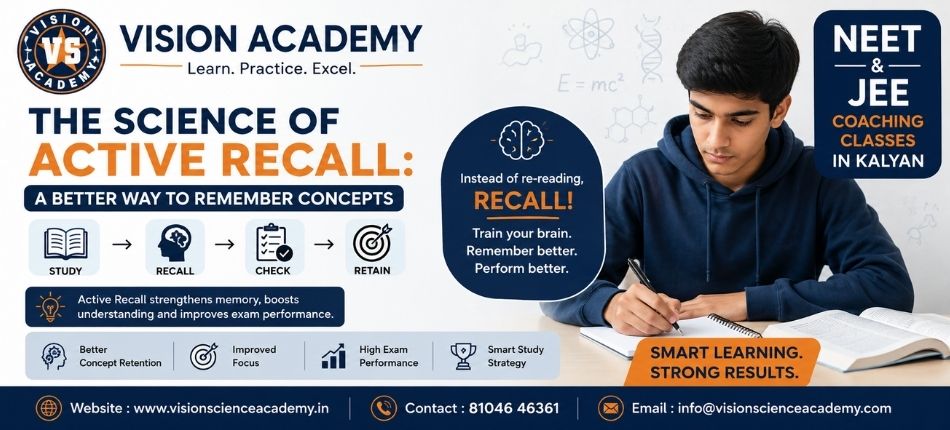
The Science of Active Recall: A Better Way to Remember Concepts | NEET & JEE Coaching Classes in Kalyan – Vision Academy
Introduction
Preparing for competitive exams like NEET and JEE requires students to understand and remember a huge amount of information. Reading textbooks repeatedly, highlighting important lines, and revising notes can be useful, but these methods alone may not always lead to strong long-term retention.
One highly effective learning technique is active recall. Instead of simply reading information again and again, active recall requires students to retrieve information from memory without immediately looking at their notes or textbooks.
At Vision Academy, students preparing for NEET and JEE can benefit from incorporating active recall into their regular study and revision routine. When combined with concept clarity, practice questions, mock tests, and systematic revision, it can make exam preparation more effective.
Join Vision Academy for NEET & JEE Coaching Classes in Kalyan. Get expert guidance, concept-based learning, regular tests, and smart exam preparation.
What Is Active Recall?
Active recall is a learning technique in which students actively try to remember previously studied information. For example, after studying a chapter, instead of immediately rereading it, a student closes the book and tries to explain the main concepts from memory.
Students can practise active recall by answering questions, solving problems without referring to solutions, using flashcards, writing down everything they remember about a topic, or teaching a concept to someone else.
The important difference is that the brain is retrieving information rather than simply seeing it again.
Why Does Active Recall Work?
When students repeatedly retrieve information from memory, they practise accessing that knowledge. This retrieval practice can strengthen learning and make information easier to recall later.
Competitive examinations require exactly this ability. During NEET or JEE, students cannot refer to their notes. They must recognise concepts, recall formulas or principles, analyse questions, and apply their knowledge within a limited time.
Therefore, practising retrieval during preparation can better resemble the mental demands students face during an examination.
Active Recall vs Passive Revision
Passive revision includes activities such as rereading chapters, highlighting sentences, watching lectures repeatedly, or going through already prepared notes.
These activities can make information feel familiar. However, familiarity does not necessarily mean that a student will be able to recall and apply the information independently during an examination.
Active recall turns revision into a question-and-answer process. After studying Newton’s Laws, for example, a student might close the textbook and ask: What are the three laws? What situations demonstrate each law? Which equations are relevant? How could the concept appear in a numerical problem?
This immediately reveals what the student actually remembers.
How NEET Students Can Use Active Recall
For NEET aspirants, active recall can be particularly useful in Biology, Chemistry, and Physics.
In Biology, students can read an NCERT section and then close the book to recall definitions, processes, diagrams, examples, and important terminology. They can also convert important NCERT statements into questions.
In Chemistry, active recall can be used for reactions, periodic trends, formulas, mechanisms, exceptions, and conceptual relationships.
In Physics, students can recall formulas along with their meaning and conditions of application. They should then solve problems without checking the solution until they have attempted the question independently.
How JEE Students Can Use Active Recall
JEE preparation requires strong conceptual understanding combined with problem-solving ability. Active recall can help students strengthen the connection between concepts and their applications.
Instead of memorising a formula in isolation, students can ask themselves: What does this formula represent? Under what conditions is it valid? Which variables are involved? How would changing one variable affect the result? What type of JEE problem might require this concept?
This approach encourages deeper understanding rather than mechanical memorisation.
Combine Active Recall With Spaced Revision
Active recall becomes even more useful when combined with spaced revision. Instead of revising the same chapter repeatedly on one day, students can revisit it after progressively longer intervals.
For example, after learning a concept, students might test themselves the next day, a few days later, and again after one or two weeks. The exact schedule can be adjusted according to difficulty and individual performance.
Topics that are repeatedly forgotten should be revised more frequently.
Use Mock Tests as Active Recall
Mock tests are another powerful form of retrieval practice. Students must recall concepts, select appropriate methods, solve questions, and manage time without relying on textbooks.
However, simply taking tests is not enough. Students should analyse incorrect and guessed answers afterward.
Ask:
- Was the concept unclear?
- Did I forget a formula?
- Did I misunderstand the question?
- Was it a calculation mistake?
- Did I take too much time?
This analysis helps convert mistakes into targeted revision.
Common Active Recall Mistakes
Students sometimes turn active recall into another form of passive learning. For example, looking at an answer too quickly does not give the brain enough opportunity to retrieve the information.
Another mistake is memorising answers without understanding the underlying concept. This can be especially problematic for JEE and numerical sections of NEET Physics and Chemistry.
Active recall should support conceptual understanding, not replace it.
How Vision Academy Helps Students Study Smarter
At Vision Academy, the focus of NEET and JEE preparation can extend beyond completing the syllabus. Effective preparation requires concept clarity, regular practice, systematic revision, doubt solving, and exam-oriented testing.
Students looking for NEET & JEE Coaching Classes in Kalyan can benefit from structured academic guidance that helps them identify weak areas, strengthen important concepts, and develop disciplined study habits.
Conclusion
The Science of Active Recall is based on a simple principle: instead of repeatedly putting information into your brain, practise bringing it back out.
For NEET and JEE aspirants, active recall can be incorporated through self-testing, flashcards, formula recall, NCERT-based questions, practice problems, and mock examinations. Combined with spaced revision and proper guidance, it can make study sessions more purposeful and help students build stronger long-term retention.
NEET & JEE Coaching Classes in Kalyan NEET & JEE Coaching Classes in Kalyan NEET & JEE Coaching Classes in Kalyan NEET & JEE Coaching Classes in Kalyan NEET & JEE Coaching Classes in Kalyan NEET & JEE Coaching Classes in Kalyan NEET & JEE Coaching Classes in Kalyan NEET & JEE Coaching Classes in Kalyan NEET & JEE Coaching Classes in Kalyan NEET & JEE Coaching Classes in Kalyan
 Previous Post
 Next Post