
Mock Test Analysis for JEE NEET
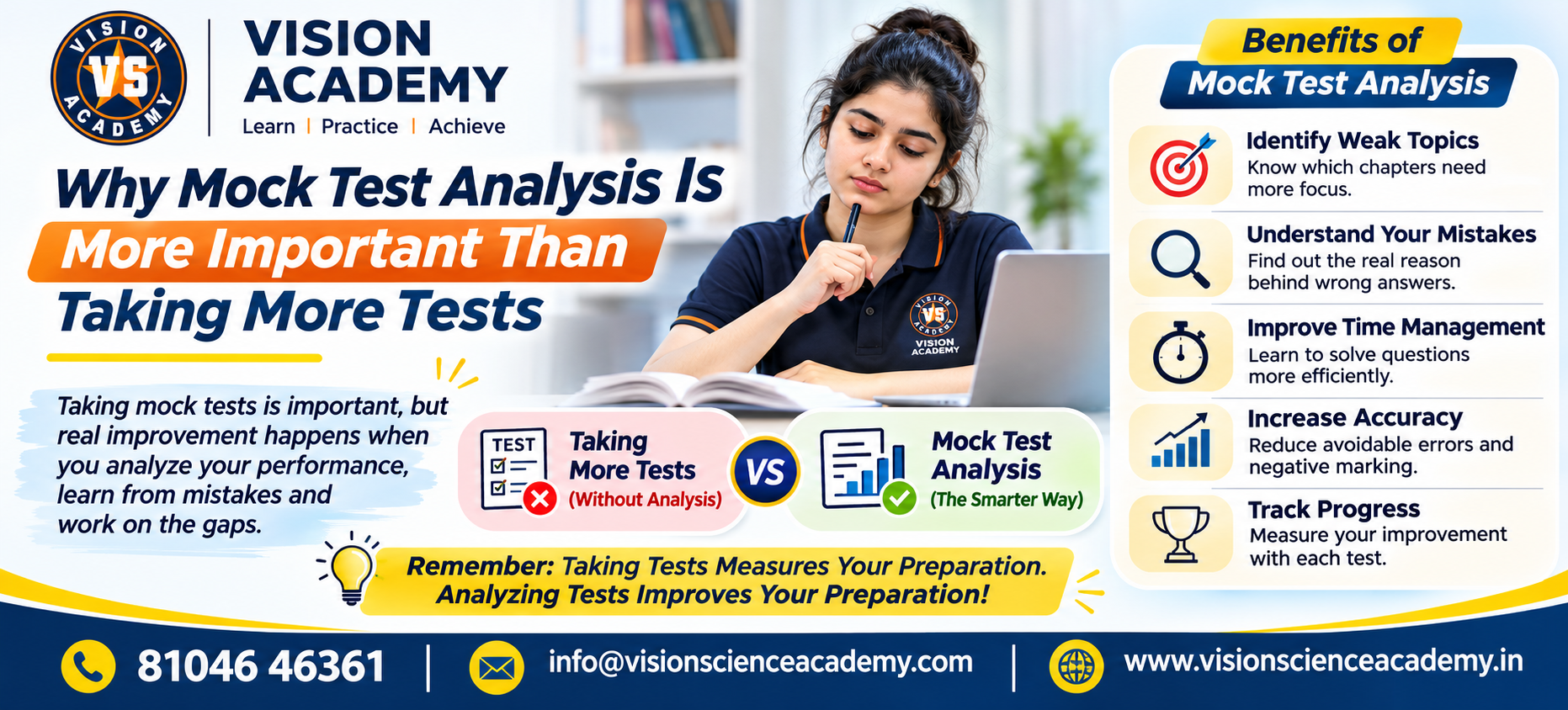
Why Mock Test Analysis Is More Important Than Taking More Tests – Vision Science Academy
Preparing for competitive entrance examinations like JEE and NEET requires consistent practice, strong conceptual understanding, effective time management, and regular performance evaluation. Many students believe that attempting more mock tests automatically leads to better scores. However, taking multiple tests without understanding mistakes may not produce the improvement they expect.
The real value of a mock test lies not only in the marks obtained but also in the information it provides about a student’s preparation. Mock Test Analysis for JEE NEET helps students identify weak concepts, understand recurring mistakes, improve question-solving strategies, and develop better examination techniques.
For example, a student may attempt ten mock tests but repeatedly lose marks because of calculation errors, poor time management, or incorrect question selection. Another student who attempts fewer tests but carefully analyzes each one may identify these problems and improve their preparation more effectively.
At Vision Science Academy, we encourage students to focus on smart preparation strategies that combine conceptual learning, regular practice, and meaningful performance evaluation. Understanding how to analyze mock tests can help JEE and NEET aspirants use their study time more productively.
In this comprehensive guide, we explain why mock test analysis matters, how to analyze test performance, common mistakes students make, and practical strategies for improving accuracy, speed, and exam readiness.
1. What Is Mock Test Analysis for JEE NEET?
Mock Test Analysis for JEE NEET is the systematic process of reviewing performance after completing a practice examination to understand strengths, weaknesses, mistakes, time management, and subject-wise accuracy. Instead of simply checking the final score, students examine each question to determine whether their answers were correct, incorrect, guessed, or left unanswered. The process also involves identifying conceptual gaps, calculation mistakes, poor question selection, and topics that require additional revision. For JEE aspirants, mock test analysis can help evaluate problem-solving speed, mathematical accuracy, and the application of Physics, Chemistry, and Mathematics concepts. For NEET aspirants, it helps assess knowledge retention, Biology accuracy, Physics calculations, and Chemistry preparation. By reviewing performance regularly, students can develop a more targeted study plan, reduce repeated mistakes, and improve their approach to competitive examinations.
2. Why Is Mock Test Analysis More Important Than Taking More Tests?
Taking mock tests is essential for competitive exam preparation, but attempting them without reviewing performance can limit their effectiveness.
The purpose of a mock test is not merely to generate a score. It is to identify what a student knows, what needs improvement, and how to perform better in the next examination.
Identifies Weak Concepts
Mock test analysis helps students identify chapters and topics where they consistently lose marks.
For example, a JEE student may struggle with rotational motion, while a NEET aspirant may frequently make mistakes in genetics or chemical equilibrium.
Recognizing these patterns allows students to prioritize revision rather than spending equal time on every chapter.
Prevents Repeated Mistakes
Without reviewing incorrect answers, students may continue making the same mistakes in future tests.
Detailed analysis helps them understand why an answer was wrong and how to avoid similar errors.
Improves Accuracy
Students can evaluate whether mistakes occur because of incomplete knowledge, calculation errors, misreading questions, or unnecessary guessing.
Improving accuracy is particularly important in examinations that include negative marking.
Develops Better Time Management
Some students understand the concepts but spend too much time on difficult questions.
Mock test analysis helps identify time-consuming question types and develop more effective question-selection strategies.
Makes Revision More Effective
Instead of revising every topic randomly, students can focus on chapters where analysis shows the greatest need for improvement.
This makes preparation more structured and efficient.
3. Taking More Mock Tests vs Analyzing Mock Tests
Both practice and analysis are necessary, but their purposes are different.
| Taking More Mock Tests | Analyzing Mock Tests |
|---|---|
| Measures current preparation | Identifies areas for improvement |
| Provides exam practice | Explains why mistakes occur |
| Builds familiarity with exam conditions | Improves question-solving strategies |
| Tests speed and accuracy | Helps identify causes of slow performance |
| Shows marks obtained | Reveals subject-wise weaknesses |
| Builds examination experience | Guides targeted revision |
Key takeaway: Taking mock tests measures your preparation, while analyzing mock tests helps you improve it.
Students should maintain a balance between test practice, analysis, concept revision, and problem-solving exercises.
4. How to Analyze a Mock Test for JEE and NEET: Step-by-Step Guide
A structured approach to Mock Test Analysis for JEE NEET can help students make better use of every practice examination.
Step 1: Review Your Overall Score
Begin by checking your total marks, attempted questions, correct answers, incorrect answers, and unanswered questions.
Compare your results with previous tests to understand whether your performance is improving.
However, avoid judging your preparation only by the total score, because different mock tests may have different difficulty levels.
Step 2: Calculate Your Accuracy Percentage
Accuracy measures how many attempted questions were answered correctly.
The formula is:
For example, if a student attempts 150 questions and answers 120 correctly:
The student’s accuracy is 80%.
Tracking accuracy alongside the number of attempts helps students understand whether they are improving their question selection and problem-solving reliability.
Step 3: Categorize Your Mistakes
Every incorrect answer should be classified according to its cause.
| Mistake Type | Example | Improvement Strategy |
|---|---|---|
| Conceptual mistake | Incorrect understanding of a formula | Revise the concept |
| Calculation mistake | Arithmetic or sign error | Practice calculations carefully |
| Silly mistake | Misreading a question | Improve attention and checking |
| Time-management mistake | Spending too long on one problem | Practice timed question sets |
| Guessing mistake | Selecting an answer without sufficient reasoning | Improve question selection |
| Memory-related mistake | Forgetting an important fact or formula | Use spaced revision |
This classification helps students understand exactly what needs improvement.
Step 4: Analyze Subject-Wise Performance
Review performance separately for each subject.
For JEE, evaluate Physics, Chemistry, and Mathematics.
For NEET, evaluate Physics, Chemistry, and Biology, including Botany and Zoology where the test report separates them.
Identify which subjects have the highest accuracy, which require more time, and which contribute most to lost marks.
Step 5: Review Unattempted Questions
Unanswered questions are just as important as incorrect answers.
Determine whether questions were skipped because of insufficient knowledge, lack of time, difficulty, or uncertainty.
Some unanswered questions may be easy to solve after a short revision, making them useful opportunities for improvement.
Step 6: Reattempt Incorrect Questions
Before checking detailed solutions, try solving incorrect questions again without a timer.
This helps distinguish between knowledge gaps and errors caused by examination pressure.
If you still cannot solve the question, revisit the underlying concept.
Step 7: Prepare a Revision Plan
Use your findings to create a targeted revision schedule.
Give priority to important topics with recurring mistakes, weak concepts, and question types that consume excessive time.
Step 8: Track Improvement in the Next Test
After revising weak areas, attempt another mock test and evaluate whether the same mistakes have decreased.
The objective is continuous improvement, not simply increasing the number of completed tests.
5. Why Understanding Mistakes Is Essential for JEE and NEET Preparation
Many students feel disappointed after scoring poorly in a mock test. However, a low score can provide valuable information when it is analyzed properly.
Every mistake reveals something about the student’s preparation.
A conceptual error indicates that a topic needs further understanding. A calculation mistake suggests that the student may benefit from additional practice. A time-management problem indicates that the examination strategy needs adjustment.
For example, if a JEE aspirant repeatedly makes mistakes in coordinate geometry, attempting more full-length tests without revising the topic may not solve the underlying problem.
Similarly, a NEET aspirant who consistently loses marks in Biology because of confusion between similar NCERT statements should focus on careful textbook revision and question review.
Effective analysis turns mistakes into actionable learning opportunities.
6. How Mock Test Analysis Helps Reduce Negative Marking
Negative marking can significantly affect performance in competitive examinations.
For papers that award four marks for a correct answer and deduct one mark for an incorrect answer, unnecessary mistakes can reduce the final score.
Students should always check the marking scheme applicable to their specific examination and paper.
Understand Your Guessing Pattern
Review questions answered without sufficient confidence.
Identify whether incorrect guesses are concentrated in particular subjects or question types.
Improve Question Selection
Students should learn to distinguish between questions they can solve confidently, questions that require additional time, and questions where they lack the necessary knowledge.
Reduce Avoidable Errors
Misreading units, overlooking negative signs, selecting the wrong option, and making calculation mistakes can lead to unnecessary mark deductions.
Use a Question-Review Strategy
When time permits, review marked questions and calculations where an error is reasonably suspected.
Avoid changing answers without a clear reason.
The goal is to make informed decisions based on knowledge, the marking scheme, and available time rather than relying on random guessing.
7. Importance of Time Management in Mock Test Analysis
Time management is one of the most important skills for JEE and NEET aspirants.
Some students know the answers but struggle to complete the paper within the allotted time.
Others spend excessive time solving difficult questions and miss easier scoring opportunities.
Mock test analysis helps students identify these problems.
Track Time Per Subject: Review whether a particular subject consistently consumes more time than expected.
Identify Time-Consuming Questions: Determine which question types slow down your performance.
Improve Question Selection: Practice moving on from questions that are not progressing, returning later when time allows.
Practice Timed Sets: Solve selected groups of questions within realistic time limits.
Maintain Accuracy: Increasing speed should not come at the expense of excessive errors.
An effective examination strategy balances speed, accuracy, confidence, and question difficulty.
8. Subject-Wise Mock Test Analysis Strategy for JEE
JEE preparation requires a strong understanding of Physics, Chemistry, and Mathematics.
Each subject benefits from a slightly different approach to analysis.
Physics Mock Test Analysis
Physics questions often require conceptual understanding, mathematical application, and careful interpretation.
Students should review whether mistakes occur because of incorrect formulas, weak conceptual understanding, unit conversion errors, or calculation difficulties.
Topics such as mechanics, electricity, magnetism, optics, and modern physics can be reviewed according to individual performance.
Chemistry Mock Test Analysis
Chemistry preparation involves conceptual knowledge, factual recall, and numerical problem-solving.
Students should identify whether mistakes are concentrated in Physical, Organic, or Inorganic Chemistry.
For Physical Chemistry, analyze calculation errors and formula applications. For Organic Chemistry, review reaction mechanisms and conceptual understanding. For Inorganic Chemistry, focus on accurate recall of relevant syllabus content.
Mathematics Mock Test Analysis
Mathematics often requires multi-step calculations and efficient problem-solving methods.
Students should review the time spent on algebra, calculus, coordinate geometry, and other syllabus topics.
Identifying unnecessarily lengthy solutions can help improve efficiency.
9. Subject-Wise Mock Test Analysis Strategy for NEET
NEET preparation requires a different balance of conceptual understanding, factual accuracy, and problem-solving speed.
Biology Mock Test Analysis
Biology performance often depends on accurate understanding and recall of textbook concepts.
Students should review incorrect answers carefully, particularly when questions involve similar terms, processes, or statements.
NCERT-based revision can help strengthen preparation for relevant syllabus topics.
Physics Mock Test Analysis
Physics may be challenging for students who struggle with numerical problems or time management.
Review incorrect formulas, calculation errors, conceptual gaps, and time-consuming questions.
Practice should focus on understanding the underlying principles rather than memorizing solutions.
Chemistry Mock Test Analysis
Students should analyze performance in Physical, Organic, and Inorganic Chemistry separately.
This helps identify whether the main difficulty involves numerical calculations, reaction understanding, or factual recall.
A targeted revision approach can make preparation more efficient.
10. How to Maintain a Mock Test Mistake Notebook
Maintaining a mistake notebook is a practical way to track recurring problems.
Students can record incorrect questions, the reasons for their mistakes, and the concepts they need to revise.
Sample Mock Test Analysis Tracker
| Topic | Mistake | Reason | Corrective Action |
|---|---|---|---|
| Physics – Current Electricity | Incorrect answer | Formula confusion | Revise formulas and solve 10 questions |
| Chemistry – Chemical Equilibrium | Calculation error | Incorrect substitution | Practice numerical problems |
| Biology – Genetics | Wrong option | Confusion between concepts | Revise relevant NCERT section |
| Mathematics – Calculus | Unattempted | Took too much time | Practice timed problem sets |
Review this notebook regularly before the next mock test.
Over time, students may notice that certain mistakes become less frequent, helping them measure improvement beyond their overall score.
11. How Much Time Should Students Spend Analyzing a Mock Test?
The ideal analysis time depends on the number of questions, difficulty level, and the student’s performance.
There is no universal rule requiring every student to spend a fixed number of hours reviewing a test.
A useful approach is to divide analysis into three stages:
-
Initial Review: Check the score, accuracy, attempted questions, and subject-wise performance.
-
Detailed Analysis: Review incorrect, skipped, and uncertain questions.
-
Corrective Revision: Revisit weak concepts and practice related questions.
A full-length examination may require several hours of analysis and follow-up revision, especially when many conceptual gaps are identified.
The quality of the review is more important than the exact duration.
12. How Many Mock Tests Should JEE and NEET Aspirants Take?
The appropriate number of mock tests depends on preparation level, examination date, syllabus completion, and individual learning needs.
Students in the early preparation stage may benefit more from chapter-wise and subject-wise tests.
As preparation progresses, part-syllabus and full-length mock tests can help build examination familiarity.
During the final revision phase, full-length tests may become more frequent, but students should still reserve adequate time for analysis and correction.
A balanced preparation cycle is:
01 Attempt Mock Test
Practice under exam conditions
02 Analyze Performance
Review mistakes and weak areas
03 Revise Concepts
Work on identified knowledge gaps
04 Practice & Retest
Check whether errors have reduced
Repeat the cycle for continuous improvement
Students should avoid taking so many tests that they have insufficient time to review mistakes, revise concepts, or maintain a healthy study routine.
13. Common Mistakes Students Make During Mock Test Analysis
Even students who regularly review their mock tests may overlook important details.
Checking Only the Final Score
A total score does not explain why marks were lost.
Students should examine accuracy, subject-wise performance, and mistake patterns.
Ignoring Correct Answers Obtained Through Guessing
A guessed correct answer may hide a conceptual weakness.
Review uncertain answers even when they are marked correct.
Not Revising Weak Topics
Identifying a weak chapter is useful only when followed by corrective revision.
Comparing Scores Without Considering Difficulty
Different mock tests may vary in difficulty and syllabus coverage.
Performance should be evaluated using multiple indicators rather than marks alone.
Repeating the Same Preparation Strategy
If a study method is not producing improvement, students should consider adjusting their revision and practice approach.
Neglecting Time Management
A student may understand concepts but still struggle because of poor question selection or inefficient time allocation.
Focusing Only on Difficult Questions
Easy and moderate questions also deserve attention, especially when avoidable errors occur.
14. How Mock Test Analysis Builds Exam Confidence
Confidence in competitive examinations develops through preparation, familiarity, and understanding of one’s abilities.
Students who regularly analyze mock tests gain a clearer picture of their strengths and weaknesses.
They begin to recognize familiar question patterns, understand which topics require more attention, and develop realistic expectations about their performance.
This can reduce uncertainty and help students approach examinations with a more structured strategy.
However, confidence should be based on consistent preparation and measurable progress rather than a single high mock test score.
15. How Vision Science Academy Helps Students Prepare for JEE and NEET
Preparing for JEE and NEET requires more than completing the syllabus. Students also need conceptual clarity, consistent practice, effective revision, and an understanding of their examination performance.
At Vision Science Academy, students can seek guidance for science and competitive examination preparation, including strategies for improving problem-solving skills, understanding difficult concepts, and developing effective study habits.
A structured approach to Mock Test Analysis for JEE NEET can help aspirants identify weak areas, improve accuracy, and use their preparation time more effectively.
By combining regular practice with careful performance evaluation, students can work toward stronger examination readiness.
Conclusion
Taking mock tests is an important part of JEE and NEET preparation, but simply attempting more tests does not guarantee better performance.
The real improvement comes from understanding mistakes, identifying weak concepts, improving accuracy, and developing effective time-management strategies.
Mock Test Analysis for JEE NEET helps students transform practice examinations into valuable learning opportunities.
Instead of focusing only on the number of tests completed, students should evaluate what they learned from each test and how they can apply those lessons to future preparation.
Remember: Taking Tests Measures Your Preparation. Analyzing Tests Improves Your Preparation!
Contact Vision Science Academy
Looking for guidance on JEE, NEET, and science examination preparation? Connect with Vision Science Academy.
81046 46361
info@visionscienceacademy.com
Mock Test Analysis for JEE NEET Mock Test Analysis for JEE NEET Mock Test Analysis for JEE NEET Mock Test Analysis for JEE NEET Mock Test Analysis for JEE NEET Mock Test Analysis for JEE NEET Mock Test Analysis for JEE NEET Mock Test Analysis for JEE NEET Mock Test Analysis for JEE NEET Mock Test Analysis for JEE NEET Mock Test Analysis for JEE NEET Mock Test Analysis for JEE NEET Mock Test Analysis for JEE NEET Mock Test Analysis for JEE NEET Mock Test Analysis for JEE NEET Mock Test Analysis for JEE NEET Mock Test Analysis for JEE NEET Mock Test Analysis for JEE NEET Mock Test Analysis for JEE NEET Mock Test Analysis for JEE NEET Mock Test Analysis for JEE NEET Mock Test Analysis for JEE NEET Mock Test Analysis for JEE NEET Mock Test Analysis for JEE NEET Mock Test Analysis for JEE NEET Mock Test Analysis for JEE NEET Mock Test Analysis for JEE NEET Mock Test Analysis for JEE NEET
 Previous Post
 Next Post