
Best Learning Methods for Students | Vision Academy
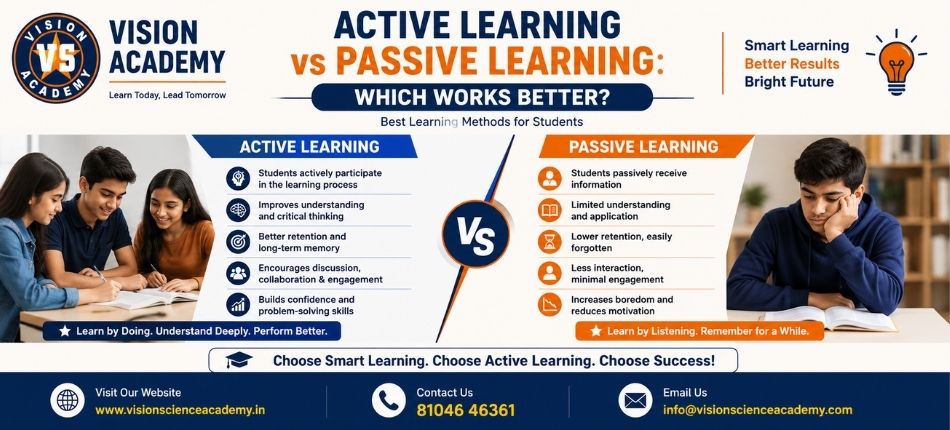
Active Learning vs Passive Learning: Which Works Better? | Best Learning Methods for Students – Vision Academy
Introduction
Every student wants to study smarter, remember concepts longer, and score higher in exams. However, the way you study plays a crucial role in your academic success. Two of the most common study approaches are active learning and passive learning. While both have their place, understanding the difference between them can help students choose the most effective strategy for better academic performance. In this blog, we compare Active Learning vs Passive Learning: Which Works Better? and explain why active learning is considered one of the best learning methods for students preparing for board exams, JEE, NEET, and MHT-CET.
What is Active Learning?
Active learning is a student-centered approach where learners actively participate in the learning process rather than simply receiving information. Instead of just reading or listening, students solve problems, answer questions, discuss concepts, take quizzes, make notes, teach others, and apply what they have learned. This method encourages critical thinking, better understanding, and long-term retention of knowledge. Active learning keeps students engaged and helps them identify their strengths and areas that need improvement.
What is Passive Learning?
Passive learning is a traditional method where students receive information without actively engaging with it. Examples include listening to lectures, reading textbooks without taking notes, or watching educational videos without practicing the concepts. While passive learning is useful for introducing new topics and gathering information, relying solely on it may result in lower retention and limited conceptual understanding. Students often find it difficult to recall information during examinations if they only use passive study techniques.
Active Learning vs Passive Learning: Key Differences
Although both learning methods contribute to education, they differ significantly in terms of student involvement and learning outcomes.
| Active Learning | Passive Learning |
|---|---|
| Student actively participates | Student mainly listens or reads |
| Improves concept clarity | Focuses on information gathering |
| Enhances critical thinking | Limited analytical involvement |
| Better memory retention | Information is easily forgotten |
| Encourages problem-solving | Less practical application |
| Increases classroom engagement | Minimal interaction |
| Ideal for competitive exams | Suitable for introductory learning |
Benefits of Active Learning
Active learning offers several advantages that directly improve academic performance. Students develop a deeper understanding of concepts because they interact with the subject instead of simply memorizing it. Regular quizzes, discussions, and problem-solving exercises strengthen memory retention and improve confidence during examinations. Active learning also encourages logical thinking, improves communication skills, and helps students become independent learners. These benefits make it particularly effective for students preparing for competitive exams where conceptual clarity is essential.
When is Passive Learning Useful?
Passive learning is not ineffective; it simply serves a different purpose. It works well when students are learning a topic for the first time, attending classroom lectures, reading textbooks, or watching educational videos to gain an overview of a subject. It provides the foundation upon which active learning techniques can be applied. Combining passive learning with regular practice creates a balanced and effective study routine.
Which Learning Method Works Better for Board and Competitive Exams?
For examinations such as SSC, HSC, CBSE, ICSE, JEE, NEET, and MHT-CET, active learning consistently produces better results. Competitive exams require conceptual understanding, problem-solving abilities, and quick recall of information rather than simple memorization. Students who regularly solve previous years’ papers, take mock tests, participate in discussions, and revise through active recall generally perform better than those who only read textbooks repeatedly.
Tips to Make Your Study Sessions More Active
Students can easily incorporate active learning into their daily routine by adopting simple strategies. Instead of repeatedly reading the same chapter, summarize concepts in your own words, solve practice questions, teach a topic to a friend, create mind maps, use flashcards, and attempt regular mock tests. Setting small learning goals and reviewing mistakes also helps strengthen understanding and improve confidence.
Why Choose Vision Academy?
At Vision Academy, we believe that effective learning goes beyond classroom teaching. Our experienced faculty focuses on concept-based education, interactive learning techniques, regular assessments, doubt-solving sessions, and personalized guidance to help students achieve academic excellence. By encouraging active participation and continuous practice, we prepare students not only for board examinations but also for competitive entrance exams such as JEE, NEET, and MHT-CET.
Conclusion
Both active and passive learning have their own importance, but active learning delivers better long-term results by improving understanding, retention, and problem-solving abilities. Students who combine classroom instruction with active study techniques are more likely to achieve higher scores and build lasting knowledge. Choosing the right learning strategy can make studying more productive, enjoyable, and successful.
Best Learning Methods for Students Best Learning Methods for Students Best Learning Methods for Students Best Learning Methods for Students Best Learning Methods for Students Best Learning Methods for Students
 Next Post