
Artificial Intelligence in Education | Vision Academy
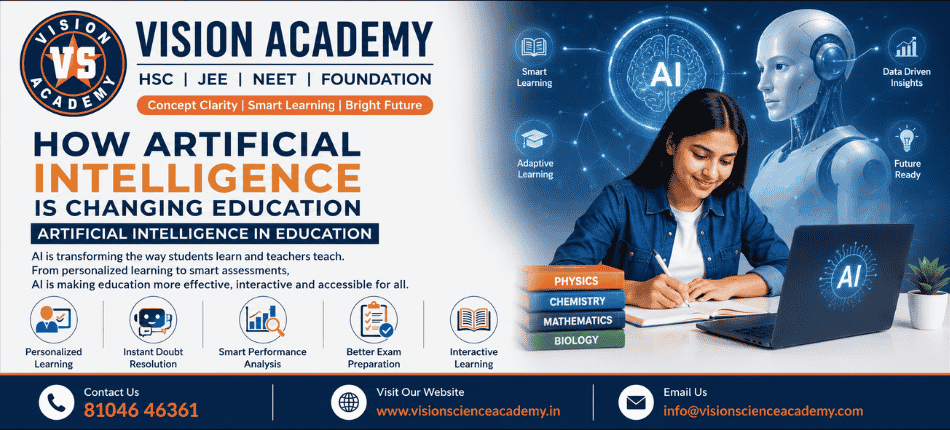
How Artificial Intelligence Is Changing Education | Artificial Intelligence in Education – Vision Academy
Education has evolved significantly over the past decade, and one of the biggest driving forces behind this transformation is Artificial Intelligence (AI). From personalized learning experiences to intelligent tutoring systems, AI is helping students learn more efficiently while enabling teachers to deliver better educational outcomes.
Today, Artificial Intelligence is no longer limited to the technology sector—it has become an integral part of classrooms, online learning platforms, and competitive exam preparation. By analyzing learning patterns, identifying strengths and weaknesses, and offering customized solutions, AI is making education more accessible, engaging, and effective than ever before.
Learn how Artificial Intelligence in Education is transforming learning through personalized study, smart assessments, and AI-powered tools with Vision Academy.
What Is Artificial Intelligence in Education?
Artificial Intelligence in education refers to the use of advanced computer systems that simulate human intelligence to improve teaching and learning. AI-powered tools can analyze student performance, recommend personalized study plans, automate routine tasks, and provide instant feedback, making the learning process smarter and more efficient.
Whether it’s solving mathematical problems, understanding scientific concepts, or preparing for competitive exams, AI is becoming a valuable educational assistant for students and teachers alike.
Why Artificial Intelligence Is Becoming Important in Education
Traditional teaching methods often follow a one-size-fits-all approach. However, every student has a unique learning style, pace, and level of understanding.
Artificial Intelligence bridges this gap by:
- Personalizing learning experiences
- Providing immediate feedback
- Tracking academic progress
- Identifying weak areas
- Improving student engagement
- Supporting teachers with data-driven insights
As a result, students receive individualized attention that helps maximize their academic potential.
Ways Artificial Intelligence Is Transforming Education
1. Personalized Learning
AI analyzes each student’s strengths, weaknesses, and learning pace to create customized study plans. Instead of following a fixed teaching approach, students receive learning materials suited to their individual needs, helping them understand concepts more effectively.
2. Instant Doubt Resolution
AI-powered educational platforms can answer questions instantly, allowing students to clear doubts without waiting for classroom sessions. This encourages continuous learning and builds confidence.
3. Smart Performance Analysis
Artificial Intelligence continuously tracks student performance through quizzes, assignments, and mock tests. It identifies weak subjects and suggests focused practice, helping students improve gradually.
4. Better Competitive Exam Preparation
Students preparing for JEE, NEET, MHT-CET, and other entrance exams benefit greatly from AI-based mock tests, adaptive practice questions, and detailed performance reports that highlight areas requiring improvement.
5. Interactive Learning Experience
AI makes learning engaging through animations, simulations, virtual laboratories, videos, and gamified lessons. Complex scientific concepts become easier to understand with visual learning.
6. Time Management Assistance
AI-powered planners help students organize study schedules, prioritize tasks, set reminders, and maintain consistency throughout the academic year.
7. Language Translation and Accessibility
Students from different linguistic backgrounds can access educational content through AI-based translation and speech recognition technologies, making quality education more inclusive.
Benefits of Artificial Intelligence in Education
Artificial Intelligence has revolutionized the learning experience by making education more personalized, interactive, and efficient. AI-powered tools can analyze a student’s learning style, strengths, and areas that need improvement, allowing them to receive customized study plans and targeted practice sessions. Students can clear doubts instantly, access interactive learning resources, and monitor their academic progress through smart performance analytics. For teachers, AI reduces administrative tasks such as grading and attendance management, giving them more time to focus on teaching. Overall, Artificial Intelligence enhances student engagement, improves academic performance, promotes self-paced learning, and makes quality education more accessible to learners from diverse backgrounds.
Challenges of Artificial Intelligence in Education
Despite its many advantages, Artificial Intelligence also presents certain challenges that need careful consideration. Overdependence on AI tools may reduce students’ critical thinking and problem-solving abilities if they rely solely on technology for answers. Concerns regarding data privacy and cybersecurity are also important, as AI systems collect and process large amounts of student information. Additionally, not every educational institution has equal access to advanced AI technologies due to infrastructure and cost limitations. AI also lacks the emotional intelligence, empathy, and mentorship that experienced teachers provide, making it unsuitable as a complete replacement for human educators. Therefore, AI should be used responsibly as a supportive learning tool rather than the sole source of education.
The Role of Teachers in an AI-Driven Classroom
Even with advanced AI technology, teachers remain the foundation of quality education. They provide mentorship, motivation, emotional support, conceptual clarity, and personalized guidance that machines cannot replicate.
The ideal learning environment combines experienced educators with AI-powered tools to create a balanced and effective educational experience.
Future of Artificial Intelligence in Education
The future of Artificial Intelligence in education is expected to bring even more innovative and personalized learning experiences. AI-powered virtual tutors, intelligent classroom assistants, adaptive learning platforms, and career guidance systems will continue to evolve, helping students learn according to their individual needs and goals. Emerging technologies such as virtual reality (VR), augmented reality (AR), and predictive analytics will create immersive classrooms where complex concepts can be understood through interactive simulations. AI is also likely to improve accessibility by offering real-time language translation, speech recognition, and personalized support for students with diverse learning needs. While technology will continue to transform education, the combination of AI-driven learning and expert teacher guidance will remain the most effective approach for building knowledge, confidence, creativity, and lifelong learning skills.
Why Choose Vision Academy?
At Vision Academy, we combine experienced faculty with modern teaching techniques to provide students with the best possible learning experience. Our focus remains on conceptual clarity, personalized guidance, regular assessments, and smart learning strategies that prepare students for HSC, JEE, NEET, and other competitive examinations.
We encourage students to use technology wisely while building strong fundamentals through expert mentoring and structured academic support.
Conclusion
Artificial Intelligence is transforming education by making learning more personalized, interactive, and efficient. While AI enhances the educational experience with smart tools and instant support, the guidance of experienced teachers remains essential for developing critical thinking, confidence, and problem-solving skills. By embracing AI responsibly alongside quality teaching, students can unlock their full academic potential and prepare for the future with confidence.
Artificial Intelligence in Education Artificial Intelligence in Education Artificial Intelligence in Education Artificial Intelligence in Education Artificial Intelligence in Education Artificial Intelligence in Education Artificial Intelligence in Education Artificial Intelligence in Education Artificial Intelligence in Education Artificial Intelligence in Education
 Previous Post
 Next Post