
Class 12 Science Revision Timetable
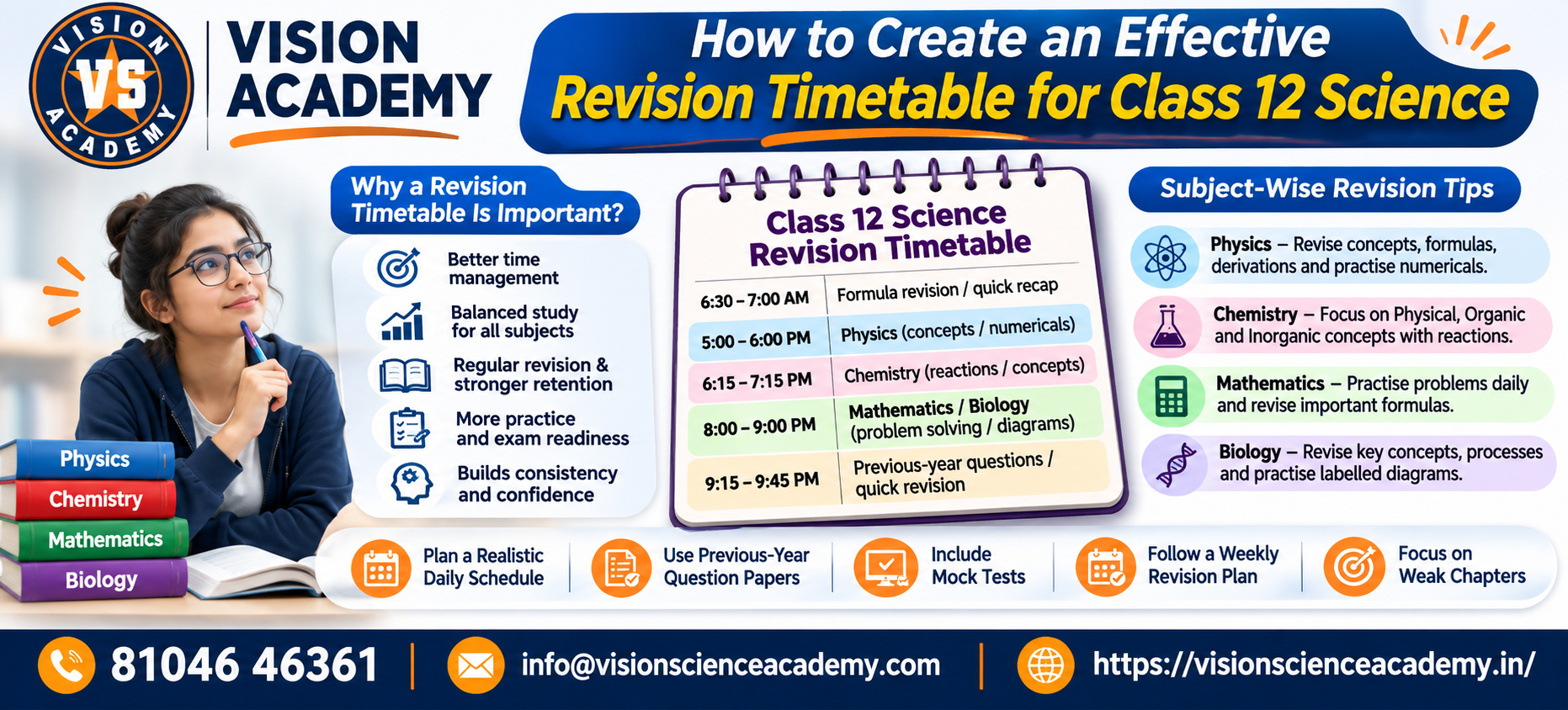
How to Create an Effective Revision Timetable for Class 12 Science – Vision Academy
Preparing for Class 12 Science board examinations can feel challenging, especially when students need to revise multiple subjects, practise numerical problems, complete assignments, and prepare for competitive entrance examinations. Without a structured study plan, students may spend too much time on familiar topics while leaving difficult chapters unfinished.
A well-organized Class 12 Science Revision Timetable helps students manage their preparation systematically, distribute study hours effectively, and revise important concepts before examinations. Whether you are studying Physics, Chemistry, Mathematics, or Biology, following a realistic timetable can improve consistency, time management, and exam readiness.
At Vision Academy in Kalyan, students preparing for Class 12 Science examinations can seek academic guidance, subject-wise preparation support, and structured learning assistance.
In this guide, we explain how to create an effective revision timetable for Class 12 Science, including subject-wise study strategies, daily schedules, weekly revision plans, effective study techniques, and common mistakes to avoid.
1. Why Is a Revision Timetable Important for Class 12 Science Students?
A revision timetable is an essential study-planning tool that helps students organize their academic preparation and make better use of available time. Class 12 Science includes concept-heavy subjects such as Physics and Chemistry, along with calculation-based Mathematics or theory-intensive Biology. Without proper planning, students may struggle to balance revision, problem-solving, practical examinations, and regular school activities. A structured Class 12 Science Revision Timetable ensures that every subject receives adequate attention while allowing additional time for difficult chapters. It also helps students track syllabus completion, schedule mock tests, revise previously studied topics, and identify areas that require improvement. Most importantly, a realistic timetable encourages consistent study habits rather than relying on last-minute preparation.
2. Understand Your Class 12 Science Syllabus Before Planning
Before preparing a revision timetable, students should carefully review the latest syllabus prescribed by their examination board.
The syllabus helps identify important chapters, practical requirements, and topics that need additional revision.
Step 1: List All Subjects
Depending on the chosen stream, Class 12 Science students may study:
- Physics
- Chemistry
- Mathematics
- Biology
- English
- Additional or elective subjects
Step 2: Divide Subjects into Chapters
Create a chapter-wise checklist for every subject.
Mark chapters as:
- Completed and well understood
- Completed but requiring revision
- Partially completed
- Not yet studied
Step 3: Identify Difficult Topics
Highlight chapters that require extra conceptual understanding, formula revision, or numerical practice.
Step 4: Review Examination Requirements
Check the latest board examination pattern, prescribed textbooks, practical requirements, and sample papers.
Study Tip: Use the official syllabus for your examination board rather than relying entirely on older chapter lists or previous-year patterns.
3. How to Create an Effective Class 12 Science Revision Timetable
Creating a successful revision timetable requires more than assigning random study hours to different subjects.
The timetable should reflect your available time, academic strengths, weaker topics, and examination schedule.
Step 1: Calculate Your Available Study Hours
Start by identifying how many hours you can realistically dedicate to self-study after school, coaching classes, meals, and other responsibilities.
For example, a student attending regular classes may have approximately three to five hours available for focused self-study on weekdays.
Avoid preparing an unrealistic timetable that leaves no time for rest.
Step 2: Prioritize Difficult Subjects
Allocate additional revision time to subjects or chapters where you need more practice.
For example, students struggling with Physics numericals may schedule regular problem-solving sessions.
Step 3: Divide Revision into Focused Sessions
Instead of studying continuously for several hours, divide your study time into manageable sessions.
A practical approach may include:
- 45–60 minutes of focused study
- 5–10 minutes of rest
- A longer break after multiple sessions
Adjust the duration according to your concentration and comfort.
Step 4: Combine Theory and Practice
Science preparation requires both conceptual understanding and application.
Include time for reading, writing answers, solving numerical problems, and practising diagrams or derivations.
Step 5: Schedule Regular Revision
Previously studied chapters should be reviewed periodically to improve retention.
Step 6: Include Mock Tests
Reserve time for chapter tests, previous-year questions, and full-length practice examinations.
Step 7: Review Your Timetable Weekly
Evaluate whether your plan is working and adjust study hours based on progress.
4. Sample Daily Revision Timetable for Class 12 Science Students
The following is an example of a weekday revision schedule for students attending school or coaching classes during the day.
| Time | Study Activity |
|---|---|
| 6:30 AM – 7:00 AM | Formula revision or quick recap |
| School / Coaching Hours | Regular classes and academic activities |
| 5:00 PM – 6:00 PM | Physics numericals or concepts |
| 6:00 PM – 6:15 PM | Short break |
| 6:15 PM – 7:15 PM | Chemistry revision |
| 7:15 PM – 8:00 PM | Dinner and rest |
| 8:00 PM – 9:00 PM | Mathematics or Biology |
| 9:00 PM – 9:15 PM | Short break |
| 9:15 PM – 9:45 PM | Previous-year questions or quick revision |
This timetable is only a sample and should be adjusted according to school timings, coaching schedules, personal energy levels, and sleep requirements.
Students should prioritize adequate sleep rather than sacrificing rest to increase study hours.
5. Subject-Wise Revision Strategy for Class 12 Science
Every Science subject requires a slightly different revision approach.
A balanced timetable should include suitable methods for each subject.
A. Physics Revision Strategy
Physics requires conceptual understanding, mathematical application, and regular numerical practice.
Students should focus on understanding fundamental principles rather than memorizing formulas without context.
Effective Physics Revision Tips:
- Revise important concepts chapter-wise.
- Maintain a formula notebook.
- Practise numerical problems regularly.
- Review important derivations.
- Solve board-style questions.
- Analyse mistakes after tests.
Students should also practise writing clear steps and including appropriate units in numerical answers.
B. Chemistry Revision Strategy
Chemistry includes Physical, Organic, and Inorganic Chemistry, each requiring a different preparation method.
Physical Chemistry: Focus on formulas, calculations, and conceptual understanding.
Organic Chemistry: Revise reaction mechanisms, functional groups, and important conversions.
Inorganic Chemistry: Review textbook concepts, chemical properties, and important reactions.
Effective Chemistry Revision Tips:
- Prepare concise chapter summaries.
- Maintain reaction and formula sheets.
- Practise numerical problems.
- Use flashcards for important concepts.
- Solve previous-year questions.
C. Mathematics Revision Strategy
Mathematics requires consistent practice and a clear understanding of problem-solving methods.
Simply reading solved examples is usually insufficient for examination preparation.
Effective Mathematics Revision Tips:
- Practise problems daily.
- Revise important formulas.
- Solve different question types.
- Focus on weak chapters.
- Practise timed question sets.
- Maintain a notebook of common mistakes.
Students should review incorrect answers and understand the steps required to solve similar questions.
D. Biology Revision Strategy
Biology preparation requires conceptual understanding, accurate terminology, and effective recall.
Effective Biology Revision Tips:
- Study prescribed textbook content carefully.
- Prepare concise notes.
- Practise labelled diagrams.
- Revise biological processes and terminology.
- Use active recall techniques.
- Solve previous-year questions.
Students should practise writing structured answers with relevant scientific terms.
6. Weekly Class 12 Science Revision Timetable
A weekly timetable helps students distribute their workload and avoid studying only one subject repeatedly.
The following sample schedule can be adapted for PCM and PCB students.
| Day | Main Revision Focus | Additional Practice |
|---|---|---|
| Monday | Physics | Numerical problems |
| Tuesday | Chemistry | Reactions and concepts |
| Wednesday | Mathematics / Biology | Problem-solving / diagrams |
| Thursday | Physics | Derivations and PYQs |
| Friday | Chemistry | Formula and reaction revision |
| Saturday | Mathematics / Biology | Chapter-wise test |
| Sunday | Weekly revision | Mock test and mistake analysis |
English and other compulsory subjects should also receive dedicated revision time during the week.
Students preparing for competitive examinations may need additional sessions for objective questions and speed-based practice.
7. How to Balance Class 12 Board Exams and JEE, NEET or MHT-CET Preparation
Many Class 12 Science students prepare for board examinations alongside competitive entrance tests such as JEE Main, NEET, or MHT-CET. Managing both requires a balanced approach because the examination formats and question-solving requirements differ. Board examinations often require structured written answers, derivations, explanations, and step-by-step solutions, while entrance examinations emphasize conceptual application, multiple-choice questions, accuracy, and time management. Students should first identify overlapping syllabus topics and revise those concepts thoroughly before practising questions in the appropriate examination format. A Class 12 Science Revision Timetable can include separate sessions for board-style answer writing and entrance-exam MCQ practice. The allocation of study time should depend on upcoming examination dates, syllabus completion, and individual preparation levels. Regular mock tests and performance analysis can help students identify whether they need more conceptual revision or problem-solving practice.
8. Best Study Techniques for Effective Class 12 Science Revision
Following a timetable is useful, but the study techniques used during revision are equally important.
Active Recall
Active recall involves testing your memory without immediately referring to notes.
For example, after studying a Physics concept, close your textbook and explain the topic in your own words.
Spaced Repetition
Spaced repetition involves revisiting information at increasing intervals rather than studying it only once.
Students may review a topic after one day, several days, and again after a longer interval, adjusting the schedule according to retention.
Practice Testing
Solving questions without referring to answers helps evaluate understanding and identify weak areas.
Interleaved Practice
Interleaving involves mixing related problem types rather than practising only one type repeatedly.
This technique can be useful for Mathematics and numerical subjects.
Concept Mapping
Concept maps help organize relationships between ideas, processes, and formulas.
Error Analysis
Maintaining a mistake notebook helps students understand recurring errors and revise the underlying concepts.
9. How to Revise Difficult Chapters Without Wasting Time
Difficult chapters often require additional attention, but spending excessive time on one topic can disrupt the overall study plan. Students should begin by identifying the specific concept or question type they find challenging rather than repeatedly reading the entire chapter. Breaking complex topics into smaller sections can make revision more manageable. For example, a difficult Physics chapter can be divided into definitions, formulas, derivations, and numerical applications. Similarly, Mathematics chapters can be revised through basic examples before progressing to more challenging problems. Students should allocate extra time to weak areas while continuing to revise other subjects regularly. If a concept remains unclear after focused effort, seeking guidance from a teacher can prevent unnecessary delays and help maintain steady progress.
10. How to Use Previous-Year Question Papers Effectively
Previous-year question papers are valuable revision resources because they help students become familiar with examination formats, question styles, and time management requirements.
Start with Chapter-Wise Questions
After completing a chapter, solve relevant questions from previous examinations.
Practise Without Looking at Solutions
Attempt questions independently before checking answers.
Use Timed Practice
Gradually introduce time limits to improve examination readiness.
Review Marking Schemes
Where available, study official marking schemes to understand how answers are evaluated.
Identify Repeated Concepts
Look for concepts that appear frequently, but do not assume that the same questions will be repeated.
Analyse Mistakes
Review incorrect answers and identify whether the problem involved conceptual understanding, calculation, memory, or time management.
11. How to Make a 30-Day Class 12 Science Revision Plan
A 30-day revision plan can help students organize final preparation when examinations are approaching.
<escape>Days 1–10: Complete Major Chapter Revision</escape>
Focus on revising important chapters across all subjects. Prioritize weaker areas and complete essential notes, formulas, and diagrams.
<escape>Days 11–20: Practice and Strengthen Weak Areas</escape>
Solve chapter-wise questions, practise numerical problems, and review topics where mistakes occur frequently.
<escape>Days 21–26: Mock Tests and Performance Analysis</escape>
Attempt timed practice papers under examination-like conditions. Review answers and identify areas requiring final improvement.
<escape>Days 27–30: Final Revision</escape>
Revise formulas, key concepts, definitions, diagrams, and frequently misunderstood topics.
Avoid trying to learn large amounts of completely new material immediately before an examination unless it is essential.
Important: This is a sample framework, not a universal timetable. Students should adjust it according to their remaining syllabus, examination dates, and individual learning needs.
12. Common Mistakes to Avoid While Creating a Revision Timetable
Even a carefully prepared timetable may become ineffective if it is unrealistic or poorly balanced.
Studying Only Favourite Subjects
Students may repeatedly revise comfortable topics while postponing difficult subjects.
Creating an Overloaded Schedule
Planning too many study hours without breaks can reduce concentration and make the timetable difficult to follow.
Ignoring Revision
Completing chapters without revisiting them may lead to forgetting important concepts.
Avoiding Mock Tests
Students who skip timed practice may struggle with examination speed and question selection.
Memorizing Without Understanding
Memorizing formulas or answers without understanding their application can make unfamiliar questions difficult.
Not Reviewing Mistakes
Repeated errors may continue when students fail to analyse incorrect answers.
Sacrificing Sleep
Insufficient sleep can negatively affect attention, memory, and overall well-being.
A successful revision timetable should be practical, flexible, and sustainable.
13. How Many Hours Should Class 12 Science Students Study Daily?
The ideal number of study hours varies depending on school schedules, coaching commitments, individual learning needs, and examination proximity. There is no fixed number of hours that guarantees good marks. For many students, approximately three to five hours of focused self-study outside regular classes may be a practical starting point, but this should not be treated as a compulsory target. Students with additional academic commitments may need a different schedule. Rather than measuring preparation only by total hours, students should focus on completing meaningful study goals, practising questions, revising difficult concepts, and reviewing mistakes. Short breaks, adequate sleep, regular meals, and physical activity are also important for maintaining concentration. A balanced Class 12 Science Revision Timetable should prioritize effective learning over unnecessarily long study sessions.
14. How to Stay Consistent with Your Revision Timetable
Consistency is one of the most important factors in effective examination preparation. Students should begin with realistic daily targets and gradually build a routine that matches their learning capacity. Keeping a visible timetable, maintaining a chapter completion checklist, and setting specific study goals can make progress easier to track. For example, instead of planning to study Chemistry for two hours without a clear objective, students can set a target to revise one concept, solve a defined number of questions, and review previous mistakes. Reducing distractions, keeping study materials organized, and scheduling regular breaks may also improve concentration. If a student misses a study session, the timetable should be adjusted rather than abandoned. Weekly progress reviews help identify areas requiring additional attention and encourage sustainable study habits.
15. Last-Minute Revision Tips for Class 12 Science Board Exams
As board examinations approach, students should focus on strengthening existing knowledge rather than attempting to cover every topic from the beginning.
Useful Last-Minute Revision Tips:
- Review important formulas and definitions.
- Practise frequently tested question formats.
- Revise diagrams and derivations.
- Review your mistake notebook.
- Solve selected previous-year questions.
- Organize examination materials in advance.
- Avoid excessive late-night studying.
- Maintain adequate sleep before examinations.
Students should also read examination instructions carefully and practise presenting answers clearly.
16. How Vision Academy Helps Class 12 Science Students with Exam Preparation
Preparing for Class 12 Science examinations requires conceptual understanding, regular practice, effective revision, and appropriate academic guidance.
At Vision Academy in Kalyan, students can seek support for Science subject preparation and structured learning.
Academic guidance can help students understand difficult concepts, improve problem-solving skills, and identify topics requiring additional practice.
Students preparing for board examinations and competitive entrance tests can benefit from combining classroom learning with consistent self-study, practice questions, and regular revision.
A personalized Class 12 Science Revision Timetable can help students organize their preparation according to individual strengths, weaker subjects, and examination goals.
Conclusion
Creating an effective Class 12 Science Revision Timetable is an important step toward organized and confident examination preparation.
A well-planned timetable helps students balance Physics, Chemistry, Mathematics, Biology, and other subjects while providing sufficient time for practice, mock tests, and repeated revision.
The most effective study plan is one that matches the student’s learning needs, available time, and examination goals.
By combining active recall, spaced repetition, regular question practice, and consistent progress reviews, students can make their revision sessions more productive.
At Vision Academy, students preparing for Class 12 Science examinations can seek academic guidance to strengthen conceptual understanding, improve study habits, and prepare systematically for upcoming examinations.
Contact Vision Academy
Vision Academy – Kalyan
Phone: +91 81046 46361
Email: info@visionscienceacademy.com
Website: https://visionscienceacademy.in/
Start Planning Your Revision Today and Prepare with Greater Confidence!
Class 12 Science Revision Timetable Class 12 Science Revision Timetable Class 12 Science Revision Timetable Class 12 Science Revision Timetable Class 12 Science Revision Timetable Class 12 Science Revision Timetable Class 12 Science Revision Timetable Class 12 Science Revision Timetable Class 12 Science Revision Timetable Class 12 Science Revision Timetable Class 12 Science Revision Timetable Class 12 Science Revision Timetable Class 12 Science Revision Timetable Class 12 Science Revision Timetable Class 12 Science Revision Timetable Class 12 Science Revision Timetable Class 12 Science Revision Timetable Class 12 Science Revision Timetable Class 12 Science Revision Timetable Class 12 Science Revision Timetable Class 12 Science Revision Timetable Class 12 Science Revision Timetable
 Previous Post
 Next Post