
Career Options After 12th Science | Vision Academy
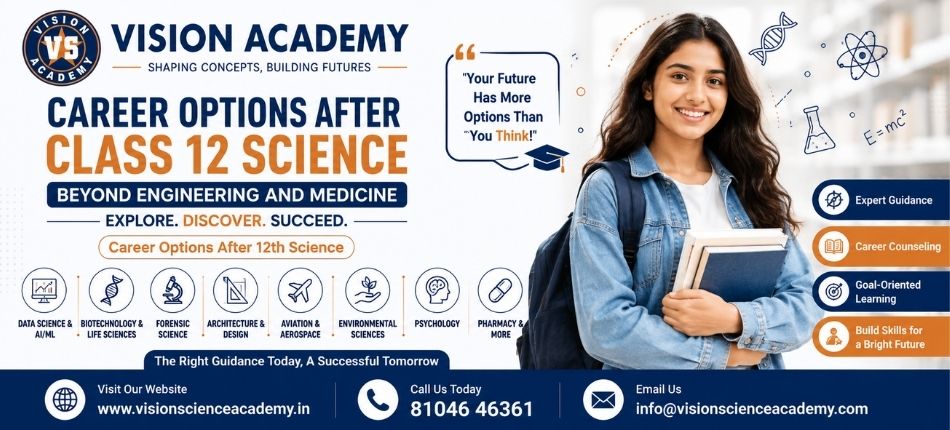
Career Options After Class 12 Science Beyond Engineering and Medicine | Career Options After 12th Science – Vision Academy
For decades, students choosing the Science stream after Class 10 have often been encouraged to follow one of two conventional paths—engineering or medicine. While both continue to offer excellent opportunities, they are certainly not the only choices available.
Today, Career Options After 12th Science have expanded considerably. Students can explore fields such as artificial intelligence, data science, biotechnology, forensic science, architecture, environmental science, aviation, psychology, research and many others.
The key is to understand your interests, abilities, subject combination and long-term goals before selecting a course.
At Vision Academy, students are encouraged to build strong fundamentals in Science while also understanding the wider possibilities available after Class 12.
Why Look Beyond Engineering and Medicine?
Engineering and medicine are respected career choices, but selecting a profession simply because it is popular may not always be the right decision.
Every student has different strengths. Someone interested in mathematics and computers may enjoy data science, while a biology student interested in laboratory work could explore biotechnology or microbiology. A student passionate about buildings and creativity might consider architecture.
Exploring different career options after Class 12 Science allows students to make decisions based on aptitude and interest rather than social pressure.
1. Data Science and Artificial Intelligence
Data Science and Artificial Intelligence have emerged as attractive technology-oriented career areas.
Data science involves collecting, processing and interpreting data to identify useful patterns and support decision-making. Artificial Intelligence focuses on creating systems capable of performing tasks associated with human intelligence, such as learning, prediction and problem-solving.
Students with strong mathematics, statistics, analytical thinking and programming interests can explore undergraduate courses related to computer science, AI, machine learning and data science.
Potential career areas include data analytics, machine learning, AI development and business intelligence.
2. Biotechnology
Biotechnology combines biology with technology to develop applications across healthcare, agriculture, pharmaceuticals, food production and environmental sciences.
Students who enjoy biology but do not necessarily want to pursue MBBS can consider biotechnology as an alternative.
Higher studies and specialization can lead to opportunities in research laboratories, biotechnology companies, pharmaceutical organizations and related industries.
3. Microbiology
Microbiology involves the scientific study of microorganisms such as bacteria, viruses, fungi and other microscopic organisms.
Students interested in laboratory science and biological research may consider courses in microbiology.
The subject can open pathways toward research, healthcare laboratories, pharmaceuticals, food science and other scientific sectors, although some professional roles may require postgraduate qualifications.
4. Forensic Science
Forensic science applies scientific methods to questions related to investigations and legal evidence.
Students may study areas such as forensic biology, forensic chemistry, toxicology and evidence analysis depending on the course and specialization.
It can be an interesting career direction for students who enjoy science, observation, analytical reasoning and laboratory-based investigation.
5. Architecture
For students who enjoy mathematics as well as creativity and design, architecture can be an interesting option.
Architecture combines technical understanding with planning, aesthetics, spatial design and problem-solving.
Students interested in this profession should carefully check current eligibility requirements and entrance procedures for recognized architecture programmes before applying.
6. Aviation
Aviation offers several career paths beyond becoming a commercial pilot.
Depending on qualifications and interests, students may explore aviation management, aircraft-related technical fields, airport operations and other specialized areas.
Requirements vary significantly between aviation careers, particularly for pilot training, so students should verify eligibility, medical requirements, licensing and training costs from the appropriate authorities before making a decision.
7. Environmental Science
Climate change, pollution, waste management and conservation have increased interest in environmental studies.
Environmental science combines aspects of biology, chemistry, geography and earth sciences to understand environmental problems and possible solutions.
Students interested in sustainability and nature may explore careers in environmental research, conservation, sustainability and related areas after obtaining appropriate qualifications.
8. Food Science and Food Technology
Food technology applies scientific principles to food production, processing, preservation, quality and safety.
Students can explore undergraduate programmes in food technology, food science or related disciplines.
With suitable qualifications, career opportunities may exist in food manufacturing, quality assurance, product development, food safety and research.
9. Pharmacy
Students interested in medicines and pharmaceutical sciences can explore pharmacy.
Pharmacy education includes subjects related to medicines, pharmaceutical chemistry, formulation and other areas of drug science.
Students should check the current eligibility and regulatory requirements for the particular pharmacy programme and professional pathway they intend to pursue.
10. Psychology
Psychology can also attract Science students interested in understanding human behaviour, cognition and mental processes.
However, students should distinguish between studying psychology academically and becoming a licensed or appropriately qualified mental-health professional. Professional requirements vary according to the role and applicable regulations.
Students considering psychology should research the complete education and qualification pathway for their intended career.
11. Pure Sciences and Research
Students who genuinely enjoy Physics, Chemistry, Biology or Mathematics can pursue pure sciences.
Courses such as B.Sc. and integrated science programmes can provide a foundation for postgraduate education and research.
Students interested in scientific discovery, academics or research institutions may eventually specialize in areas ranging from physics and chemistry to biological and mathematical sciences.
12. Defence Services
Science students may also consider careers in India’s defence services.
Different entry routes have their own eligibility requirements involving education, age, physical standards, examinations and selection procedures.
Students interested in this direction should refer to current official recruitment notifications because requirements can change.
PCM Career Options After 12th
Students studying Physics, Chemistry and Mathematics (PCM) can explore many areas beyond conventional engineering, including mathematics, statistics, data science, computer science, architecture, aviation, defence, physics and research.
The best choice depends on the student’s strengths. A student strong in mathematics and logical reasoning may prefer quantitative or technology-oriented careers, while someone with creative and mathematical abilities may explore architecture or design-related programmes.
PCB Career Options After 12th
Students with Physics, Chemistry and Biology (PCB) are also not limited to MBBS.
Depending on eligibility and interests, options can include biotechnology, microbiology, pharmacy, life sciences, environmental science, food science and research-oriented programmes.
Each programme has different admission requirements, so students should verify eligibility before making final decisions.
How to Choose the Right Career After 12th Science
Instead of asking only, “Which career has the highest salary?”, students should consider several factors together:
- Which subjects do I genuinely enjoy?
- What are my strongest academic areas?
- Do I prefer practical, analytical, creative or research-oriented work?
- What qualifications will the career require?
- How many years of education are involved?
- What entrance examinations are necessary?
- What are the realistic costs of the course?
- What type of work environment would suit me?
A career decision should balance interest, aptitude, educational requirements and realistic opportunities.
Role of Strong Science Fundamentals
Regardless of which career a student eventually chooses, strong fundamentals in Physics, Chemistry, Mathematics and Biology can make higher-level learning easier.
Understanding concepts rather than relying entirely on memorization is particularly valuable for competitive examinations and science-based undergraduate programmes.
This is why consistent preparation during Classes 11 and 12 is important even when a student has not finalized a career.
How Vision Academy Supports Science Students
Vision Academy focuses on helping students strengthen their academic foundation through conceptual understanding, systematic preparation, regular practice and appropriate guidance.
Strong subject knowledge can help students prepare not only for board examinations but also for competitive examinations and future science-related academic programmes.
Conclusion
Engineering and medicine remain valuable career paths, but they represent only a part of the opportunities available to today’s Science students.
From Artificial Intelligence and biotechnology to forensic science, aviation, environmental science, pharmacy and research, there are numerous Career Options After 12th Science worth exploring.
Students should research each option carefully, understand eligibility requirements and choose a direction that aligns with their interests, abilities and long-term goals.
Career Options After 12th Science Career Options After 12th Science Career Options After 12th Science Career Options After 12th Science Career Options After 12th Science Career Options After 12th Science Career Options After 12th Science Career Options After 12th Science Career Options After 12th Science Career Options After 12th Science Career Options After 12th Science Career Options After 12th Science
 Previous Post
 Next Post