
Effective Revision Techniques | Vision Academy
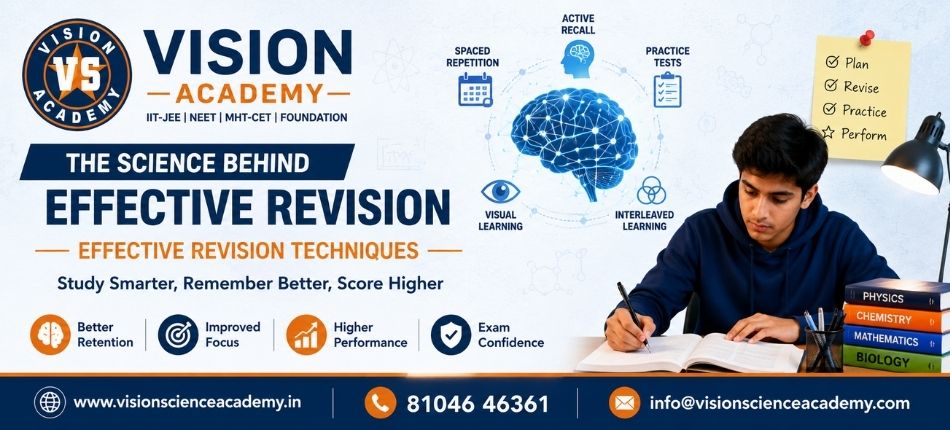
The Science Behind Effective Revision | Effective Revision Techniques – Vision Academy
Preparing for competitive exams like JEE, NEET, MHT-CET, Board Exams, and Olympiads requires much more than simply reading textbooks repeatedly. The real secret behind academic success lies in understanding how the human brain learns and remembers information.
Many students spend countless hours studying but struggle to recall concepts during exams because they rely on ineffective revision habits. Scientific research has shown that using the right revision methods significantly improves memory retention, understanding, and confidence.
In this article, we’ll explore the science behind learning and the effective revision techniques that help students perform at their best.
Why Revision Is More Important Than Studying Again
Revision is not simply rereading notes.
Instead, it strengthens the neural pathways in your brain that store information. Every time you actively recall information, your brain reinforces those memories, making them easier to retrieve during examinations.
Without regular revision, the brain gradually forgets what it has learned. This phenomenon is known as the Forgetting Curve, introduced by psychologist Hermann Ebbinghaus.
Students who revise strategically retain concepts for a much longer period than those who only study once.
Understanding the Forgetting Curve
Research suggests that people can forget nearly 50% of newly learned information within a day if they don’t review it.
After a week, even more information disappears unless revision takes place.
This is why students often feel they “know everything” after studying but forget most of it during exams.
Regular revision interrupts this forgetting process and converts short-term memories into long-term knowledge.
Active Recall: The Brain’s Favorite Learning Method
One of the most effective revision techniques is Active Recall.
Instead of reading the answer repeatedly, students should attempt to remember the information without looking at their notes.
Examples include:
- Solving questions without notes
- Explaining concepts aloud
- Writing answers from memory
- Using flashcards
- Self-testing
Active Recall forces the brain to retrieve stored information, strengthening memory every time it is used.
Spaced Repetition Improves Long-Term Memory
Spaced repetition is one of the most effective revision techniques because it helps transfer information from short-term memory to long-term memory. Instead of revising a topic multiple times in one day, students should review it at increasing intervals—such as after one day, three days, one week, and two weeks. This method reinforces learning before the brain begins to forget the information, making it easier to recall concepts during exams. Regular spaced revision also reduces the need for last-minute cramming and builds stronger retention over time.
Practice Tests Strengthen Brain Connections
Taking regular practice tests is much more than evaluating your preparation—it actively strengthens the brain’s ability to retrieve information. Solving mock exams, previous years’ question papers, and topic-wise quizzes trains the brain to recall concepts under timed conditions. It also helps students identify weak areas, improve accuracy, and build confidence before the actual examination. The more students practice recalling information, the stronger their memory pathways become, leading to better exam performance.
Interleaved Learning Makes Revision More Effective
Interleaved learning involves studying different subjects or topics within the same revision session instead of focusing on only one subject for several hours. For example, a student may revise Mathematics, followed by Physics, and then Chemistry. This approach encourages the brain to differentiate between concepts, improves problem-solving skills, and prevents boredom. Interleaved learning also prepares students for real examinations, where questions from multiple topics appear together and require flexible thinking.
Visual Learning Helps the Brain Remember Faster
The human brain processes visual information much faster than plain text, making visual learning an excellent revision strategy. Using mind maps, flowcharts, diagrams, charts, infographics, and color-coded notes helps students organize complex information into simple, memorable formats. Visual aids improve understanding, make revision more engaging, and enable quicker recall during exams. They are particularly useful for subjects that involve processes, relationships, formulas, and classifications.
Teach Someone Else
One of the strongest learning methods is teaching.
When students explain a topic to someone else, they identify gaps in their understanding and organize concepts more clearly.
Even explaining a chapter aloud to yourself improves comprehension.
This technique is often called the Feynman Technique, which encourages simple explanations of complex topics.
Common Revision Mistakes Students Should Avoid
Some common mistakes include:
- Revising only favorite subjects
- Ignoring weak topics
- Studying continuously without breaks
- Not solving practice papers
- Depending only on textbooks
- Last-minute cramming
- Skipping revision altogether
Avoiding these habits leads to more balanced preparation.
Why Choose Vision Academy?
At Vision Academy, we believe that success comes from smart learning rather than just hard work. Our experienced faculty guide students with scientifically proven revision strategies, structured study plans, regular mock tests, doubt-solving sessions, and personalized mentoring. We focus on conceptual clarity, consistent practice, and effective revision techniques that help students excel in board exams as well as competitive entrance examinations.
Conclusion
Effective revision is based on science, not guesswork. Understanding how the brain learns enables students to study more efficiently and remember information longer. Techniques like Active Recall, Spaced Repetition, practice testing, visual learning, proper sleep, and consistent revision can dramatically improve academic performance.
By adopting these effective revision techniques and maintaining discipline, students can reduce exam stress, improve confidence, and achieve outstanding results.
Effective Revision Techniques Effective Revision Techniques Effective Revision Techniques Effective Revision Techniques Effective Revision Techniques Effective Revision Techniques Effective Revision Techniques
 Previous Post
 Next Post