
Coaching vs Self-Study
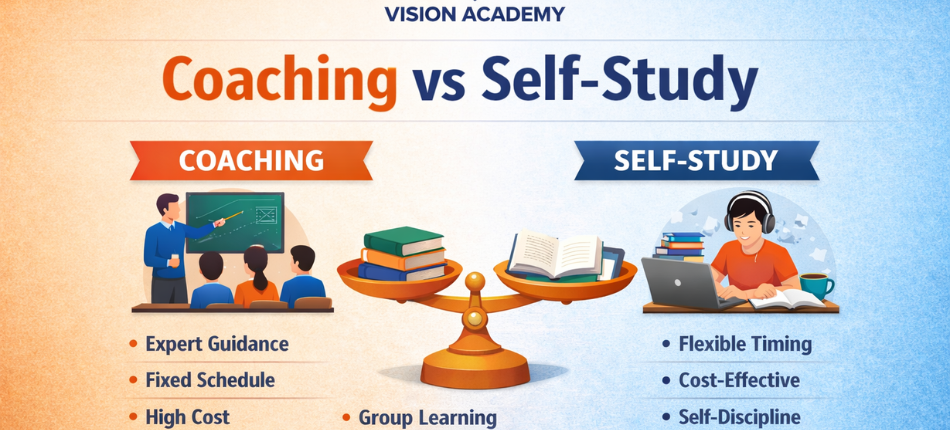
Coaching vs Self-Study – Which is Better for Academic Success? | Vision Academy
Introduction
When it comes to exam preparation, one common question students ask is: Coaching vs Self-Study – which is better? Every student has a unique learning style, and choosing the right preparation method plays a crucial role in academic success. At Vision Academy, we guide students to make informed decisions that help them achieve excellent results.
In this blog, we will compare coaching classes and self-study in detail so you can understand what works best for you.
What is Self-Study?
Self-study refers to learning independently without formal classroom coaching. Students rely on textbooks, online resources, practice papers, and personal discipline to prepare for exams.
Advantages of Self-Study
1.Flexible Schedule
One of the biggest advantages of self-study is the flexibility it offers. Students can create their own timetable based on their most productive hours, whether early morning or late at night. Unlike coaching classes with fixed timings, self-study allows learners to adjust their schedule according to school, extracurricular activities, or personal commitments. This flexibility helps reduce stress and improves concentration because students study when they feel mentally fresh and focused.
2. Cost-Effective
Self-study is a budget-friendly option since it does not require paying tuition or coaching fees. Students can prepare using textbooks, reference books, online resources, and free educational platforms. For families looking to reduce educational expenses, self-study can be a practical choice. With proper planning and access to the right study materials, students can achieve excellent academic results without investing heavily in coaching classes.
3. Independent Learning Skills
Self-study helps students develop essential life skills such as self-discipline, time management, and problem-solving ability. When students take responsibility for their own learning, they learn how to plan their syllabus, set goals, and track progress. This independence builds confidence and prepares them for higher education and competitive exams, where self-motivation and consistent effort are key to success.
4. Customized Learning Pace
Every student has a different learning speed, and self-study allows complete control over that pace. Students can spend extra time understanding difficult concepts and quickly revise topics they already know well. There is no pressure to match the speed of a classroom. This personalized learning approach improves clarity and ensures better retention of information, leading to stronger academic performance.
Disadvantages of Self-Study
Self-study can be challenging because students do not receive expert guidance to explain difficult concepts clearly. Without a structured learning plan, it becomes hard to manage time and complete the syllabus effectively. Clearing doubts is also difficult since there is no teacher available for immediate support. Additionally, students may struggle with procrastination and distractions, which can reduce productivity. Therefore, self-study works best for highly disciplined, focused, and self-motivated students.
What is Coaching?
Coaching refers to structured classroom or guided learning under experienced teachers. Institutes like Vision Academy provide professional guidance, planned syllabus coverage, doubt-solving sessions, and exam-oriented preparation.
Why Coaching Gives an Edge
Professional coaching institutes like Vision Academy provide:
1. Concept-Based Learning
Concept-based learning focuses on building strong fundamentals rather than encouraging rote memorization. Teachers explain topics in depth, ensuring students understand the logic and reasoning behind every concept. This approach helps students apply their knowledge effectively in exams, especially in subjects like Mathematics and Science where clarity is essential. When concepts are clear, students can solve even tricky questions with confidence.
2. Exam-Oriented Preparation
Exam-oriented preparation ensures that students are well-prepared for the actual exam pattern and question format. Teachers provide important questions, previous year papers, and conduct regular mock tests to improve speed and accuracy. This practice helps students understand marking schemes, manage time efficiently, and reduce exam anxiety. As a result, students feel more confident and prepared on exam day.
3. Performance Tracking
Regular assessments and tests help track a student’s academic progress. By analyzing test results, teachers can identify strengths and areas that need improvement. This systematic evaluation allows students to focus more on weak topics and improve gradually. Performance tracking also helps maintain consistency and encourages continuous learning.
4. Personal Mentoring
Personal mentoring provides individualized attention to each student based on their performance and learning style. Teachers guide students with customized study strategies, doubt-clearing sessions, and improvement plans. This one-on-one support boosts confidence and ensures that no student feels left behind. Personalized guidance often makes a significant difference in overall academic results.
5. Motivation & Confidence Building
A positive and supportive learning environment plays a crucial role in student success. Regular encouragement, appreciation, and healthy competition motivate students to perform better. When students receive guidance and recognition for their efforts, their self-confidence increases. This confidence helps them stay focused, overcome challenges, and achieve their academic goals.
Disadvantages of Coaching
Coaching classes can be expensive, which may not be affordable for every student. They usually follow a fixed schedule, leaving less flexibility for personal study time. In large batches, individual attention may be limited, making it difficult for some students to clear doubts properly. Additionally, over-dependence on coaching can reduce independent learning skills.
The Ideal Formula: Coaching + Self-Study
The most effective strategy for academic success is a balanced combination of coaching and self-study. Coaching provides expert guidance, structured learning, and exam-oriented preparation, while self-study helps students revise concepts, practice regularly, and strengthen their understanding independently. When students attend classes to learn new topics and then dedicate time at home to revise and solve additional questions, their retention and confidence improve significantly. This combination ensures concept clarity, consistent practice, and better time management. Ultimately, blending coaching with disciplined self-study creates a powerful formula for achieving higher scores and long-term academic success.
Why Choose Vision Academy?
Vision Academy stands out as a trusted coaching institute because of its commitment to quality education and student success. The academy focuses on concept clarity, structured syllabus coverage, and regular assessments to ensure consistent academic improvement. With experienced teachers, small batch sizes, and personalized attention, every student receives the guidance they need to excel. Regular mock tests, doubt-solving sessions, and motivational support help build confidence and strong exam readiness. At Vision Academy, the goal is not just scoring high marks, but developing disciplined, confident, and successful learners.
Conclusion
Both coaching and self-study have their benefits. However, structured coaching combined with disciplined self-study is the most effective strategy for achieving top results.
If you are looking for expert guidance and consistent success, Vision Academy is here to help you reach your academic goals.
Coaching vs Self-Study Coaching vs Self-Study Coaching vs Self-Study Coaching vs Self-Study Coaching vs Self-Study Coaching vs Self-Study Coaching vs Self-Study Coaching vs Self-Study Coaching vs Self-Study Coaching vs Self-Study Coaching vs Self-Study Coaching vs Self-Study Coaching vs Self-Study Coaching vs Self-Study
 Previous Post
 Next Post