
JEE NEET and Board Exam Preparation
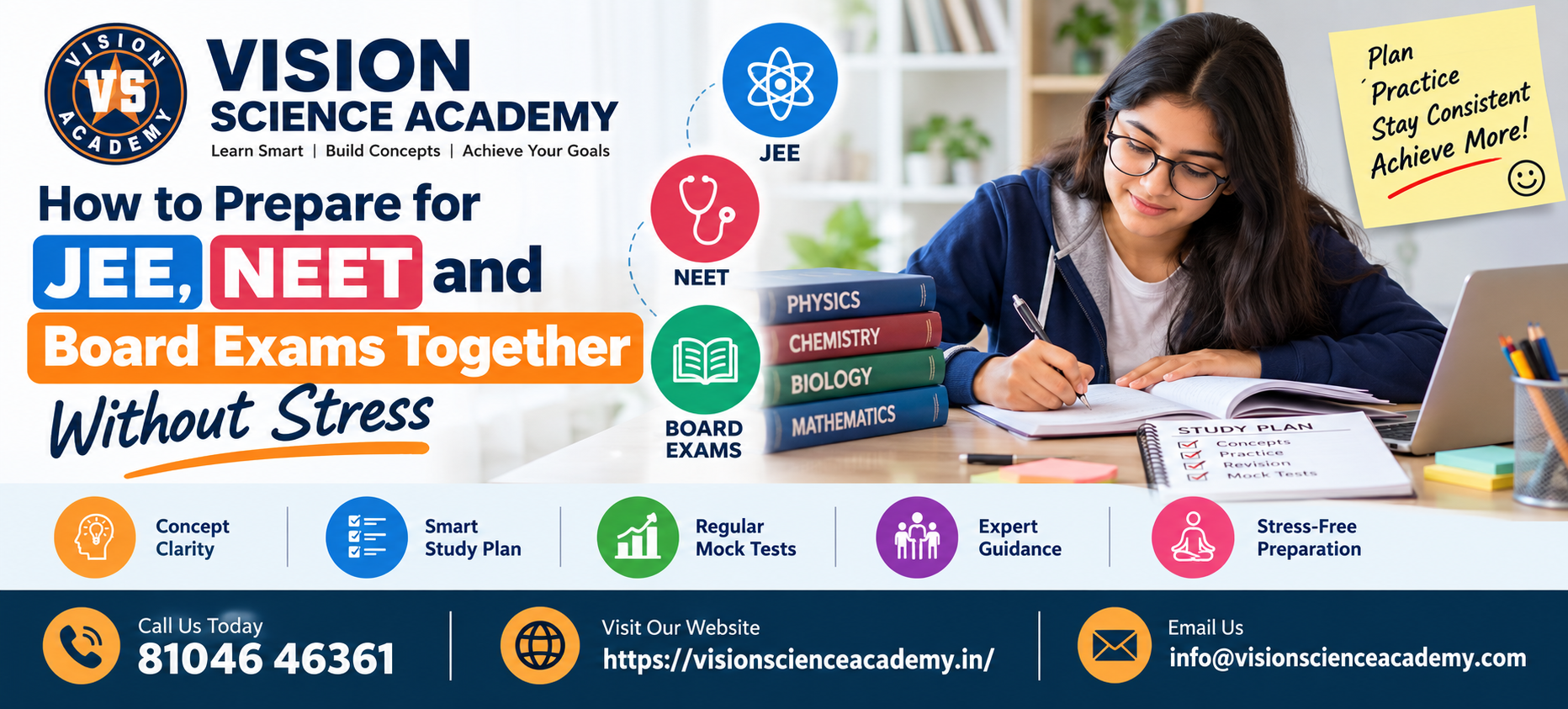
How to Prepare for JEE, NEET and Board Exams Together Without Stress | Vision Science Academy
Introduction
Preparing for JEE, NEET, and Board examinations is one of the most important academic challenges for science students in Classes 11 and 12. Students often feel overwhelmed when they have to manage school assignments, practical examinations, competitive entrance preparation, mock tests, and regular revision simultaneously.
The biggest concern among students is how to prepare for competitive exams without affecting their board examination performance. Many students believe they need completely separate study schedules for each examination, which often leads to confusion, unnecessary pressure, and inefficient time management.
However, JEE NEET and Board Exam Preparation becomes more manageable when students understand the overlap between school and entrance exam syllabi and follow a realistic study strategy.
JEE and NEET require strong conceptual understanding, analytical thinking, and problem-solving skills, while board examinations also assess subject knowledge through written answers, explanations, numerical problems, and practical understanding.
With the right approach, students can build a strong academic foundation that supports both their board examinations and their chosen competitive entrance examination.
At Vision Science Academy, the importance of conceptual clarity, systematic learning, regular practice, and academic discipline is emphasized to help students approach examinations with greater confidence.
In this guide, we will explore practical strategies for balancing JEE or NEET preparation with board examinations, creating an effective study timetable, improving revision techniques, and managing examination-related stress.
1. Understanding the Difference Between JEE, NEET and Board Exams
Before creating a study plan, students must understand the examination patterns and preparation requirements.
Although these examinations share several academic topics, their question formats and assessment methods differ.
JEE – Joint Entrance Examination
The Joint Entrance Examination is an important entrance examination for students seeking admission to engineering programmes.
JEE Main primarily evaluates students’ understanding of Physics, Chemistry, and Mathematics through objective questions and numerical problem-solving.
Students preparing for JEE need strong conceptual knowledge, analytical ability, accuracy, and effective time management.
JEE Advanced requires additional depth and flexibility in applying concepts.
NEET – National Eligibility cum Entrance Test
NEET UG is the entrance examination used for admission to undergraduate medical courses in India.
The examination focuses on Physics, Chemistry, and Biology.
NEET preparation requires detailed understanding of biological concepts, familiarity with the prescribed syllabus, accuracy in multiple-choice questions, and regular practice.
NCERT textbooks are especially important for building foundational understanding, particularly in Biology.
Class 11 and 12 Board Examinations
Board examinations assess students’ understanding of their prescribed school syllabus.
Depending on the board and subject, questions may include short answers, long answers, numerical problems, diagrams, and practical applications.
Students need to develop clear written explanations, appropriate presentation, and familiarity with the marking scheme.
JEE vs NEET vs Board Exams: Key Differences
| Factor | JEE | NEET | Board Exams |
|---|---|---|---|
| Main Purpose | Engineering admissions | Medical admissions | School academic assessment |
| Core Subjects | Physics, Chemistry, Mathematics | Physics, Chemistry, Biology | Subjects prescribed by the board |
| Question Style | Objective and numerical | Primarily MCQs | Written and other formats |
| Main Skills | Problem-solving and application | Conceptual accuracy and recall | Understanding and written presentation |
| Preparation Approach | Concepts and extensive problem practice | NCERT study and MCQ practice | Textbooks, written answers and past papers |
Students usually prepare for either JEE or NEET alongside their board examinations, depending on their career goals. They do not generally need to prepare for both entrance examinations unless they are intentionally pursuing both pathways.
2. Why Students Feel Stressed During JEE, NEET and Board Exam Preparation
Examination stress often develops because students feel they have too many subjects and insufficient time.
Understanding the reasons behind this pressure can help students adopt healthier study habits.
A. Heavy Academic Syllabus
Class 11 and 12 science subjects cover a wide range of topics.
Students may struggle when they attempt to complete several chapters without adequate revision.
B. Pressure to Score High Marks
Students often feel pressure to perform well in both board examinations and competitive entrance tests.
Unrealistic expectations can reduce motivation and increase anxiety.
C. Poor Time Management
Without a clear timetable, students may spend too much time on familiar subjects while neglecting difficult topics.
D. Lack of Regular Revision
Studying a chapter once is rarely sufficient for long-term retention.
Students who do not revise regularly may forget important concepts before examinations.
E. Comparing Performance With Others
Constantly comparing mock test scores or study hours with classmates may increase unnecessary stress.
Every student has different strengths, learning needs, and progress rates.
F. Inadequate Sleep and Breaks
Long study sessions without sufficient rest can affect concentration, memory, and emotional well-being.
A balanced preparation strategy should address both academic requirements and personal well-being.
3. Create a Smart Study Timetable for JEE, NEET and Board Exams
A well-structured timetable is one of the most effective tools for managing multiple examination requirements.
Students should create a realistic schedule based on school timings, coaching classes, personal strengths, and available study hours.
Sample Daily Study Timetable for Class 12 Students
The following example assumes the student attends school or coaching during the day.
| Time | Study Activity |
|---|---|
| 6:30 AM – 7:00 AM | Formula revision or quick concept review |
| 7:00 AM – 2:00 PM | School and regular academic activities |
| 2:00 PM – 3:00 PM | Lunch and rest |
| 3:00 PM – 4:30 PM | Coaching, homework or difficult concepts |
| 4:30 PM – 5:00 PM | Break and physical activity |
| 5:00 PM – 6:30 PM | JEE/NEET practice questions |
| 6:30 PM – 7:30 PM | Dinner and relaxation |
| 7:30 PM – 8:30 PM | Board examination answer-writing practice |
| 8:30 PM – 9:00 PM | Revision and next-day planning |
This is an illustrative timetable, not a mandatory routine. Students should adapt it to their actual school and coaching schedules and ensure adequate sleep.
Tips for Creating an Effective Timetable
-
Set realistic daily learning targets.
-
Give additional attention to difficult subjects.
-
Include both entrance exam and board-style questions.
-
Schedule short breaks between study sessions.
-
Keep dedicated time for revision.
-
Reserve time for exercise, meals, and sufficient sleep.
-
Review your progress at the end of each week.
A timetable should support learning rather than become another source of pressure.
4. Focus on Common Topics Between Board Exams and Competitive Exams
One of the smartest ways to manage JEE NEET and Board Exam Preparation is to identify topics that overlap between the syllabi.
Many fundamental concepts in Physics, Chemistry, Mathematics, and Biology are relevant to both school and entrance examinations.
Instead of studying the same chapter separately for different exams, students can combine conceptual learning with different question formats.
Physics
Common areas may include:
-
Laws of Motion
-
Work, Energy and Power
-
Electrostatics
-
Current Electricity
-
Magnetism
-
Optics
-
Modern Physics
Students can first understand the theoretical concepts and then practise numerical problems.
Chemistry
Important overlapping areas may include:
-
Chemical Bonding
-
Thermodynamics
-
Chemical Equilibrium
-
Electrochemistry
-
Organic Chemistry
-
Coordination Compounds
Students should focus on understanding reactions, chemical principles, and relevant numerical applications.
Mathematics for JEE Aspirants
Important areas include:
-
Algebra
-
Trigonometry
-
Calculus
-
Coordinate Geometry
-
Vectors
-
Probability
JEE aspirants should strengthen fundamentals before attempting more advanced questions.
Biology for NEET Aspirants
Important areas include:
-
Cell Biology
-
Human Physiology
-
Genetics
-
Reproduction
-
Biotechnology
-
Ecology
NEET aspirants should pay close attention to the prescribed NCERT content and regularly practise application-based MCQs.
Always verify the latest official examination syllabi because topics and weightage can change.
5. Follow the Concept First, Practice Later Approach
A common mistake students make is attempting difficult competitive examination questions without understanding the basic concepts.
This often leads to confusion and unnecessary frustration.
A more effective approach involves three stages.
Stage 1: Understand the Concept
Begin with the relevant textbook chapter.
Read the explanation carefully and understand important definitions, formulas, diagrams, and principles.
Stage 2: Practise Board-Level Questions
After understanding the chapter, solve textbook exercises and board-style questions.
This improves written presentation, calculation accuracy, and subject understanding.
Stage 3: Solve JEE or NEET Questions
Once the fundamentals are clear, practise competitive examination questions related to the same chapter.
This approach reduces duplication and helps students apply their knowledge in different examination formats.
For example, after studying Current Electricity, a student can solve textbook numerical problems, practise written explanations, and then attempt relevant entrance examination MCQs.
6. Subject-Wise Preparation Strategy for JEE, NEET and Board Exams
Different subjects require different learning techniques.
Physics Preparation Strategy
Physics requires conceptual clarity and consistent numerical practice.
Students should:
-
Understand formulas instead of memorizing them without context.
-
Practise numerical problems regularly.
-
Review important derivations required for board examinations.
-
Solve previous year questions.
-
Maintain a formula notebook.
-
Analyse mistakes after practice sessions.
JEE aspirants may need additional practice with multi-step and advanced application problems.
NEET aspirants should focus on syllabus-relevant conceptual and numerical questions.
Chemistry Preparation Strategy
Chemistry includes Physical, Organic, and Inorganic Chemistry.
Physical Chemistry: Focus on formulas, concepts, and numerical problems.
Organic Chemistry: Understand reaction mechanisms, functional groups, and important transformations.
Inorganic Chemistry: Study prescribed textbook content carefully and revise factual information regularly.
Students should combine textbook learning with board questions and entrance exam practice.
Mathematics Preparation for JEE
Mathematics requires repeated problem-solving.
Students should practise different question types, understand standard methods, and improve calculation accuracy.
A useful strategy is to maintain a notebook containing important formulas and common mistakes.
Biology Preparation for NEET
Biology preparation requires careful reading, understanding, and regular revision.
Students should:
-
Study the prescribed NCERT chapters thoroughly.
-
Understand diagrams and biological processes.
-
Create short revision notes.
-
Practise chapter-wise MCQs.
-
Review incorrect answers.
-
Revise frequently tested concepts.
Avoid relying entirely on memorization without understanding the underlying biological principles.
7. Use NCERT Textbooks as Your Academic Foundation
NCERT textbooks are valuable resources for many students preparing for CBSE board examinations and competitive entrance tests.
They provide structured explanations of fundamental concepts.
However, students should also follow the textbooks prescribed by their respective school boards.
Why NCERT Books Are Important
-
They explain fundamental concepts systematically.
-
They provide useful examples and exercises.
-
They support understanding of many entrance examination topics.
-
They help students build a foundation before using advanced reference books.
-
They are especially useful for NEET Biology preparation.
For JEE, additional practice resources are often needed to develop higher-level problem-solving skills.
Students should avoid collecting too many reference books without completing their primary study material.
8. Practise Previous Year Question Papers Regularly
Previous year question papers are valuable tools for understanding examination patterns.
They help students identify common question styles, assess their preparation, and practise completing papers within the available time.
Benefits of Solving Previous Year Papers
Understanding Question Patterns: Students become familiar with how concepts are tested.
Improving Time Management: Timed practice helps students learn how to distribute their time.
Identifying Weak Areas: Incorrect answers highlight topics that need further attention.
Building Confidence: Familiarity with examination formats may reduce uncertainty.
Improving Answer Presentation: Board examination papers help students practise structured written responses.
Students should use authentic papers and current examination patterns rather than assuming that older formats remain unchanged.
9. Take Regular Mock Tests and Analyse Your Performance
Mock tests help students evaluate their preparation under examination-like conditions.
However, simply attempting multiple tests is not enough.
The real improvement comes from reviewing the results.
How to Analyse a Mock Test
After completing a test, divide incorrect answers into categories:
-
Conceptual mistakes.
-
Calculation errors.
-
Misreading the question.
-
Time management problems.
-
Unattempted questions due to incomplete preparation.
Then create a targeted improvement plan.
For example, if a student repeatedly makes mistakes in Electrostatics, they should revisit the relevant concepts and practise similar problems before taking another test.
Students should focus on gradual improvement rather than becoming discouraged by individual mock test scores.
10. Create a Weekly Revision Strategy
Regular revision helps students retain important concepts over time.
Without revision, previously studied material may become difficult to recall.
A practical weekly plan could look like this:
| Day | Revision Focus |
|---|---|
| Monday | Physics concepts and numerical problems |
| Tuesday | Chemistry formulas and reactions |
| Wednesday | Mathematics or Biology |
| Thursday | Board examination answer writing |
| Friday | Weak chapters and difficult questions |
| Saturday | Chapter-wise mock test and analysis |
| Sunday | Light revision, planning, and rest |
Students should adjust this schedule according to their chosen entrance examination.
Effective Revision Techniques
Active Recall: Close the book and try to explain the topic from memory.
Spaced Revision: Revisit concepts after increasing intervals.
Formula Sheets: Keep important formulas organized.
Flashcards: Use them for definitions, reactions, and factual information.
Practice Questions: Test your understanding instead of repeatedly rereading notes.
Error Notebook: Record mistakes and review them before examinations.
These techniques can help students make revision more focused and productive.
11. How to Balance Board Exam Writing Practice With JEE and NEET MCQs
One of the biggest differences between board examinations and competitive entrance tests is the way students are expected to answer questions.
Board examinations often require descriptive answers, diagrams, derivations, and clear explanations.
JEE and NEET generally focus on selecting or calculating correct answers within a limited time.
Students should practise both formats.
For Board Exams
Focus on:
-
Writing clear and complete answers.
-
Using appropriate scientific terminology.
-
Practising diagrams where required.
-
Showing calculation steps.
-
Following the prescribed marking scheme.
-
Completing papers within the time limit.
For JEE and NEET
Focus on:
-
Understanding question requirements.
-
Improving accuracy.
-
Practising time-bound MCQs.
-
Learning efficient problem-solving methods.
-
Reviewing incorrect answers.
-
Understanding the current marking scheme.
Combining both approaches helps students prepare without unnecessarily repeating the same theory.
12. How to Manage Stress During JEE, NEET and Board Exam Preparation
Academic preparation should not come at the cost of physical and emotional well-being.
Excessive stress may affect concentration, sleep, motivation, and daily functioning.
A. Avoid Unrealistic Study Targets
Studying for extremely long hours does not automatically produce better results.
Focus on completing meaningful learning tasks rather than counting study hours alone.
B. Take Regular Breaks
Short breaks between study sessions can help students maintain attention and reduce fatigue.
C. Maintain a Healthy Sleep Routine
Teenagers generally need around 8–10 hours of sleep per night. Adequate sleep supports learning, memory, and overall well-being.
D. Include Physical Activity
Walking, stretching, sports, or other enjoyable activities can provide a useful break from prolonged sitting.
E. Avoid Constant Comparison
Every student learns at a different pace.
Track your own improvement instead of comparing every mock test score with classmates.
F. Discuss Academic Difficulties
Students should feel comfortable discussing difficult topics or examination concerns with teachers, parents, or mentors.
G. Seek Support When Stress Becomes Overwhelming
If examination anxiety significantly affects sleep, appetite, daily activities, or emotional well-being, students should seek support from a trusted adult or qualified mental health professional.
A balanced routine supports both learning and personal well-being.
13. Common Mistakes Students Should Avoid
Students preparing for competitive and board examinations should avoid certain habits that reduce study efficiency.
Studying Without a Plan
Randomly switching between subjects may leave important chapters incomplete.
Ignoring Weak Subjects
Avoiding difficult topics can create larger knowledge gaps.
Using Too Many Reference Books
Collecting multiple books without completing them may lead to confusion.
Skipping Mock Test Analysis
Taking tests without reviewing mistakes limits their usefulness.
Ignoring Board Exam Preparation
Entrance examination preparation does not automatically guarantee strong written board examination performance.
Neglecting Health
Skipping meals, sleeping too little, or studying without breaks can reduce concentration and increase fatigue.
Last-Minute Cramming
Trying to learn several new chapters immediately before an examination may increase stress.
Consistent preparation is generally more sustainable than irregular, intensive study sessions.
14. Three-Month Preparation Strategy Before Major Examinations
The final three months before an examination are important for revision and performance improvement.
Students should adapt their schedules to the actual board and entrance examination dates.
Month 1: Strengthen Concepts and Complete Pending Topics
Focus on completing important syllabus areas and resolving conceptual doubts.
Prioritize chapters that are relevant to the current official syllabus.
Month 2: Increase Practice and Revision
Begin more frequent timed practice sessions.
Solve previous year papers and review weak topics.
Maintain separate revision materials for formulas, diagrams, reactions, and frequently missed concepts.
Month 3: Focus on Mock Tests and Final Revision
Use full-length practice papers to improve examination readiness.
Review the error notebook and revise important concepts.
Avoid unnecessary changes in study resources.
As board examinations approach, increase written-answer practice. After the relevant board papers are completed, students may devote more attention to their upcoming entrance examination.
15. How Coaching Guidance Can Support Exam Preparation
Students sometimes find it difficult to identify their weaknesses or create a realistic study strategy independently.
Structured academic guidance can help students organize their preparation.
Potential benefits of suitable coaching support include:
Conceptual Clarity: Teachers can explain difficult topics and help students strengthen their fundamentals.
Structured Learning: A planned approach can reduce confusion about which topics to study.
Doubt Resolution: Students can ask questions and clarify misunderstandings.
Regular Practice: Practice exercises and assessments help students apply what they learn.
Performance Feedback: Reviewing mistakes can help identify areas requiring additional attention.
Study Planning: Academic guidance can help students balance board preparation with their chosen entrance examination.
Students should evaluate a coaching institute’s actual teaching approach, faculty, schedule, and available academic support before enrolling.
16. JEE NEET and Board Exam Preparation – Vision Science Academy
Preparing for board examinations and competitive entrance tests requires a combination of subject knowledge, consistent practice, revision, and effective time management.
Vision Science Academy supports students exploring science education and preparation for important academic examinations.
Students seeking guidance for Physics, Chemistry, Mathematics, or Biology can enquire about the academy’s current programmes and available learning support.
A well-structured preparation strategy can help students approach their examinations with greater confidence while maintaining a balanced academic routine.
For more information, visit Vision Science Academy.
Conclusion
Managing JEE NEET and Board Exam Preparation can initially appear challenging, but a smart and balanced approach can make the process more manageable.
Students should focus on understanding concepts, identifying overlapping syllabus topics, following realistic study schedules, practising previous year questions, and revising consistently.
Regular mock tests, effective time management, and appropriate academic guidance can support examination readiness.
Equally important is maintaining healthy sleep habits, taking breaks, and avoiding unnecessary pressure.
Success in competitive and board examinations requires consistent effort, patience, and a willingness to learn from mistakes.
With a structured approach, students can prepare for their academic goals while maintaining a healthier balance between study and personal well-being.
Start Your Exam Preparation Journey With Vision Science Academy
VISION SCIENCE ACADEMY – Learn Smart, Prepare Confidently!
Looking for academic guidance for JEE, NEET, or Class 11 and 12 science subjects? Contact Vision Science Academy to enquire about available coaching programmes.
Contact Vision Science Academy Today and Take the Next Step Toward Your Academic Goals!
JEE NEET and Board Exam Preparation JEE NEET and Board Exam Preparation JEE NEET and Board Exam Preparation JEE NEET and Board Exam Preparation JEE NEET and Board Exam Preparation JEE NEET and Board Exam Preparation JEE NEET and Board Exam Preparation JEE NEET and Board Exam Preparation JEE NEET and Board Exam Preparation JEE NEET and Board Exam Preparation JEE NEET and Board Exam Preparation JEE NEET and Board Exam Preparation JEE NEET and Board Exam Preparation JEE NEET and Board Exam Preparation JEE NEET and Board Exam Preparation JEE NEET and Board Exam Preparation JEE NEET and Board Exam Preparation JEE NEET and Board Exam Preparation JEE NEET and Board Exam Preparation JEE NEET and Board Exam Preparation JEE NEET and Board Exam Preparation JEE NEET and Board Exam Preparation JEE NEET and Board Exam Preparation JEE NEET and Board Exam Preparation JEE NEET and Board Exam Preparation JEE NEET and Board Exam Preparation JEE NEET and Board Exam Preparation
 Previous Post