
PCB Career Options Without NEET | Vision Academy
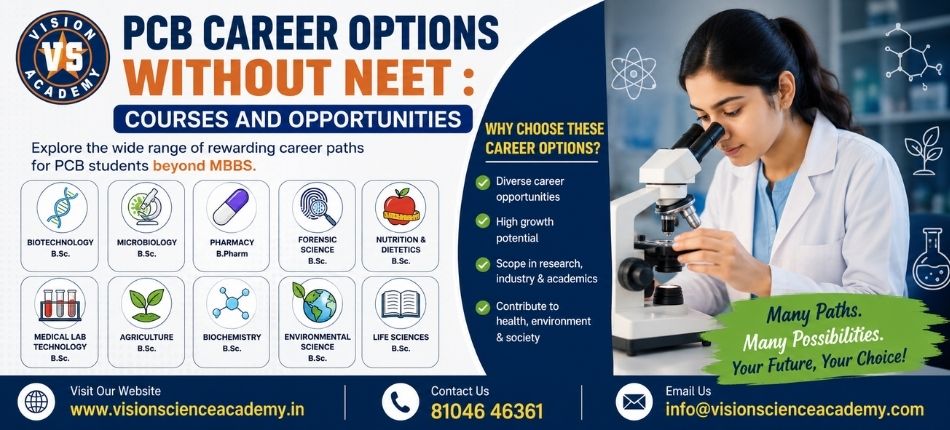
PCB Career Options Without NEET : Courses and Opportunities- Vision Academy
Many students who choose Physics, Chemistry, and Biology (PCB) in Classes 11 and 12 believe that becoming a doctor is their main career option. While MBBS and some medical pathways require NEET, there are many other rewarding fields available to PCB students.
From biotechnology and pharmacy to microbiology, nutrition, forensic science, agriculture, and laboratory technology, students can explore several PCB career options without NEET based on their interests and long-term goals.
Understanding these alternatives early can help students make informed decisions instead of treating NEET as their only possible route after Class 12.
Can PCB Students Build a Career Without NEET?
Yes. PCB students have access to a wide range of undergraduate programs that generally do not require NEET. Admission requirements vary according to the course, institution, and applicable entrance or merit criteria.
Students can pursue careers in scientific research, pharmaceuticals, biotechnology, diagnostics, food and nutrition, agriculture, environmental science, and several allied fields.
The important step is to understand the eligibility criteria and career scope of each course before applying.
Best PCB Career Options Without NEET
1. B.Sc. Biotechnology
Biotechnology combines biology with technology to study and develop products and processes useful in healthcare, agriculture, food science, and industry.
Students learn subjects such as genetics, molecular biology, cell biology, biochemistry, and microbiology.
After graduation, students may explore roles in biotechnology companies, research laboratories, pharmaceutical organizations, quality control, and related industries. Higher studies can further expand research and specialized career opportunities.
2. B.Sc. Microbiology
Microbiology focuses on microorganisms such as bacteria, fungi, viruses, and other microscopic organisms.
The course introduces students to areas such as microbial genetics, immunology, medical microbiology, industrial microbiology, and laboratory techniques.
Graduates may explore opportunities in research laboratories, pharmaceutical companies, food industries, quality-control laboratories, and other microbiology-related sectors. Advanced qualifications may be required for specialized research or clinical roles.
3. Bachelor of Pharmacy (B.Pharm)
For students interested in medicines and the pharmaceutical industry, B.Pharm can be an important PCB course without NEET.
The curriculum typically covers pharmaceutical chemistry, pharmacology, pharmaceutics, drug formulation, and related subjects.
Depending on applicable qualifications, registration requirements, and further studies, graduates may explore opportunities in pharmaceutical manufacturing, quality assurance, regulatory affairs, research, sales, and other pharmacy-related areas.
4. B.Sc. Forensic Science
Students interested in science, investigation, and laboratory analysis may consider forensic science.
The field applies scientific techniques to the examination and analysis of evidence. Students may study forensic biology, chemistry, toxicology, fingerprints, and investigative laboratory techniques.
Career opportunities may exist in forensic laboratories, research, private laboratories, and related sectors, although specific government or technical roles can have additional eligibility requirements.
5. Nutrition and Dietetics
Students interested in food, nutrition, wellness, and human biology can explore courses in nutrition and dietetics.
These programs generally cover nutrition science, food science, human physiology, diet planning, and related subjects.
Depending on qualifications and professional requirements, graduates may work in wellness organizations, food companies, research, community nutrition, healthcare-related environments, or pursue higher education.
6. Medical Laboratory Technology
Medical Laboratory Technology focuses on laboratory procedures that support the testing and analysis of clinical samples.
Students can learn about pathology, microbiology, biochemistry, hematology, and laboratory procedures depending on the program.
This can lead to opportunities in diagnostic laboratories, hospitals, pathology laboratories, and healthcare organizations, subject to the qualifications and regulations applicable to the role.
7. Agriculture and Agricultural Sciences
PCB students interested in plants, food production, sustainability, and agricultural science can explore agriculture-related courses.
Depending on the program, students may study plant science, soil science, agricultural biotechnology, crop management, and related areas.
Graduates may pursue opportunities in agricultural businesses, research organizations, food industries, government-related sectors, or higher education.
8. Biomedical and Life Sciences
Biomedical science and broader life-science courses allow students to study human biology, disease mechanisms, genetics, biochemistry, and laboratory science.
These fields can provide a foundation for careers in research, biotechnology, pharmaceutical organizations, scientific laboratories, and further academic study.
How to Choose the Right PCB Course Without NEET
Choosing a career should not depend only on which course appears popular. Students should consider their interests, academic strengths, course curriculum, eligibility requirements, higher-study opportunities, and long-term career goals.
For example, students interested in laboratory research may prefer biotechnology or microbiology, while those interested in medicines may consider pharmacy. Students interested in food and wellness can explore nutrition, while those interested in investigation may find forensic science appealing.
Researching universities, entrance requirements, course recognition, and career pathways before applying is essential.
Skills PCB Students Should Develop
Along with academic knowledge, students can benefit from developing:
- Scientific reasoning and analytical skills
- Laboratory and practical skills
- Communication abilities
- Research and observation skills
- Data interpretation
- Problem-solving abilities
- Digital and technical skills
- Time management
These skills can be useful across several science-related career pathways.
Is NEET the Only Good Option for PCB Students?
No. NEET is important for specific medical programs, but it should not be viewed as the only measure of career success for PCB students.
Science offers multiple career pathways, and the right choice depends on the student’s interests, aptitude, qualifications, and professional goals.
Exploring alternatives can also help students create a backup plan while preparing for competitive examinations.
Conclusion
There are numerous PCB career options without NEET for students who want to build careers in science, research, pharmaceuticals, biotechnology, diagnostics, nutrition, agriculture, and other related fields.
Courses such as B.Sc. Biotechnology, B.Sc. Microbiology, B.Pharm, Forensic Science, Nutrition and Dietetics, Medical Laboratory Technology, and Life Sciences provide different academic and professional pathways.
Students should carefully compare course eligibility, curriculum, institution quality, higher-study requirements, and career opportunities before making their final decision.
PCB Career Options Without NEET PCB Career Options Without NEET PCB Career Options Without NEET PCB Career Options Without NEET PCB Career Options Without NEET PCB Career Options Without NEET PCB Career Options Without NEET PCB Career Options Without NEET PCB Career Options Without NEET
 Previous Post
 Next Post