
Spaced Revision for Competitive Exams |Vision Academy
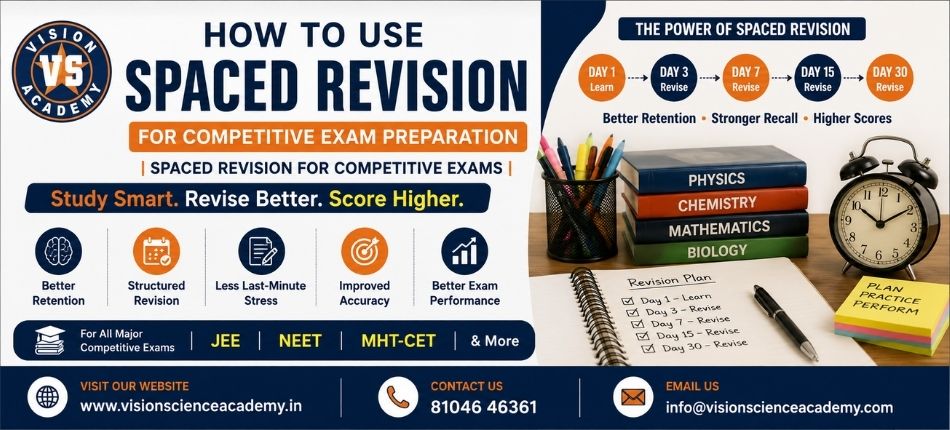
How to Use Spaced Revision for Competitive Exam Preparation | Spaced Revision for Competitive Exams – Vision Academy
Introduction
Preparing for competitive exams such as JEE, NEET, MHT-CET and other entrance examinations requires students to remember a large amount of information for months. Many students understand a chapter when they first study it but struggle to recall formulas, concepts, reactions, or important facts later.
The problem is often not a lack of studying—it is a lack of systematic revision.
Spaced Revision for Competitive Exams is a study technique in which students revise previously learned information at planned intervals rather than repeatedly studying the same material in one sitting.
When combined with active recall, question-solving, mock tests, and proper planning, spaced revision can help students strengthen long-term memory and make exam preparation more organized.
What Is Spaced Revision?
Spaced revision, also known as spaced practice, involves reviewing information multiple times with gaps between each revision.
Instead of studying one chapter five times in a single day, you might revise it today, again after a few days, then after a week, and later after a longer interval.
For example:
Day 1 → Day 3 → Day 7 → Day 15 → Day 30
The exact schedule does not have to be identical for every student or topic. Difficult concepts may need more frequent revision, while well-understood topics can be reviewed at longer intervals.
Why Do Students Forget What They Study?
Learning something once does not guarantee that it will remain easily accessible in memory.
Students often forget concepts because they:
- Study a chapter only once
- Depend heavily on rereading
- Do not test themselves
- Leave revision until the final weeks
- Focus only on new chapters
- Avoid previously difficult topics
- Revise without solving questions
Competitive exams require students to retrieve concepts quickly and apply them to questions. Therefore, revision should focus not only on recognition but also on active recall and application.
Why Is Spaced Revision Useful for Competitive Exams?
Competitive exam syllabi are extensive. By the time students finish later chapters, concepts studied several months earlier may become difficult to recall.
A structured spaced revision strategy helps students continuously revisit older topics while progressing through new ones.
Potential benefits include:
Better Long-Term Retention
Revisiting concepts periodically helps reinforce previously learned information instead of allowing it to remain untouched for months.
Less Last-Minute Pressure
When revision happens throughout the preparation period, students do not have to revise the entire syllabus from scratch immediately before the examination.
Identification of Weak Topics
Repeated revision makes it easier to notice formulas, concepts, or question types that are frequently forgotten.
Better Exam Recall
Combining spaced revision with active recall helps students practise retrieving information instead of merely recognizing it from textbooks.
How to Create a Spaced Revision Schedule
There is no single schedule that works perfectly for every student. However, a simple starting structure can be:
First Revision – Within 24 Hours
After completing a chapter, quickly revise important concepts, formulas, diagrams, definitions, and key points within the next day.
The goal is not to study the entire chapter again. Instead, try to recall what you learned and identify what you have already forgotten.
Second Revision – After 3 Days
Return to the chapter after approximately three days.
Instead of immediately opening your notes, first try recalling important concepts from memory. Then check your notes and correct anything you missed.
Third Revision – After 7 Days
After approximately one week, solve questions related to the topic.
Include conceptual questions, numerical problems, MCQs, and previous-year questions where appropriate.
Fourth Revision – After 15 Days
After 15 days, revise the topic again to check how much information you can recall without referring to your notes. Focus mainly on important concepts, formulas, difficult questions, and previously forgotten points. Solve a few practice questions to test your understanding. Topics where you still make mistakes should be scheduled for another revision sooner.
Fifth Revision – After 30 Days
Conduct another recall-based revision after approximately one month.
If you can remember and apply the topic confidently, future revision intervals can often be increased. If you continue making mistakes, bring the topic back into your schedule sooner.
Combine Spaced Revision With Active Recall
Spaced revision becomes more useful when students actively try to retrieve information.
Instead of reading the same notes repeatedly, close the book and ask yourself:
What are the main concepts of this chapter?
Which formulas do I remember?
Can I explain this concept without looking at the textbook?
Can I solve a question without checking the solution?
After attempting recall, check the material and identify what you missed.
This makes revision more active and helps expose knowledge gaps.
Use Short Notes and Formula Sheets
Create short notes and formula sheets containing only important formulas, concepts, reactions, definitions, diagrams, and exceptions. These condensed notes make revision faster because you do not need to read the entire chapter again. Keep them organized chapter-wise so they can be quickly reviewed before tests. Update them whenever you discover an important new point or repeated mistake.
Use Spaced Revision for Physics
Physics requires conceptual understanding as well as problem-solving ability.
During revision:
First stage: Recall concepts and formulas.
Second stage: Solve basic application questions.
Third stage: Solve mixed and previous-year questions.
Later stages: Focus on difficult problems and mistakes from previous tests.
Avoid spending every revision session only reading theory.
Use Spaced Revision for Chemistry
Chemistry contains different types of learning requirements.
Physical Chemistry
Revise formulas, concepts, calculations, and numerical problem-solving.
Organic Chemistry
Revise reaction mechanisms, conversions, named reactions, reagents, and important exceptions.
Inorganic Chemistry
Regular short revision can be especially useful because many facts, trends, reactions, and exceptions require repeated recall.
Create concise notes so you do not need to read entire chapters during every revision cycle.
Maintain an Error Notebook
An error notebook helps you track mistakes made during practice questions, previous-year papers, and mock tests. Write down the question or concept, why you made the mistake, and the correct method or formula. Review this notebook regularly during your spaced revision sessions. This can help prevent you from repeating the same mistakes in future tests.
Don’t Give Every Topic the Same Revision Frequency
This is an important part of efficient Spaced Revision for Competitive Exams.
Suppose you have three chapters:
Chapter A: Strong
Chapter B: Average
Chapter C: Weak
There is little benefit in spending exactly the same revision time on all three.
Strong chapters can gradually have longer revision gaps, while weak chapters should return more frequently.
This creates a personalized revision system.
Use Spaced Revision for Mathematics
For Mathematics, spaced revision should focus more on problem-solving than simply reading formulas. Start each revision by recalling important formulas and methods, then solve questions from previously completed chapters. Include difficult and previously incorrect questions in later revision sessions. Regular practice helps you remember not only formulas but also when and how to apply them.
Use Spaced Revision for Biology
Biology requires regular revision because students need to remember terminology, processes, diagrams, facts, and concepts. Use active recall, short notes, diagrams, flashcards, and chapter-wise MCQs during revision. Revisit difficult facts and commonly confused concepts more frequently. For competitive exams such as NEET, keep revision aligned with the prescribed syllabus and study material.
Use Mock Tests as Revision Tools
Mock tests are useful not only for checking scores but also for identifying areas that need further revision. After every test, analyze incorrect answers, guessed questions, forgotten concepts, and time-consuming problems. Add these weak areas to your upcoming spaced revision schedule. Regular test analysis makes revision more focused and helps improve exam preparation over time.
Common Spaced Revision Mistakes
Revising by Rereading Only
Reading notes repeatedly can create familiarity without guaranteeing recall.
Ignoring Question Practice
Competitive exams test application. Revision should therefore include questions.
Creating an Unrealistic Schedule
Planning dozens of revisions every day eventually becomes difficult to maintain.
Ignoring Weak Chapters
Students often enjoy revising topics they already know because it feels productive. Weak topics usually deserve greater attention.
Making Too Many Notes
Your revision material should become shorter over time, not longer.
How Vision Academy Can Help Students Prepare Strategically
At Vision Academy, competitive exam preparation can combine concept building, question practice, revision, test analysis, and structured preparation.
A systematic study strategy helps students avoid relying entirely on last-minute revision.
By combining spaced revision, active recall, regular problem-solving, previous-year questions, and mock-test analysis, students can build a more organized preparation routine for competitive exams.
Conclusion
Success in competitive exams is not determined only by how many hours you study. What matters is whether you can remember and apply what you have studied when the exam requires it.
Spaced Revision for Competitive Exams provides a structured way to revisit concepts before they are completely forgotten.
Start with shorter revision intervals and gradually increase the gap as your understanding improves. Combine this method with active recall, question practice, error analysis, and mock tests for a more effective preparation strategy.
Spaced Revision for Competitive Exams Spaced Revision for Competitive Exams Spaced Revision for Competitive Exams Spaced Revision for Competitive Exams Spaced Revision for Competitive Exams Spaced Revision for Competitive Exams Spaced Revision for Competitive Exams Spaced Revision for Competitive Exams Spaced Revision for Competitive Exams Spaced Revision for Competitive Exams Spaced Revision for Competitive Exams Spaced Revision for Competitive Exams Spaced Revision for Competitive Exams Spaced Revision for Competitive Exams
 Previous Post
 Next Post