
Question Solving for JEE and NEET | Vision Academy
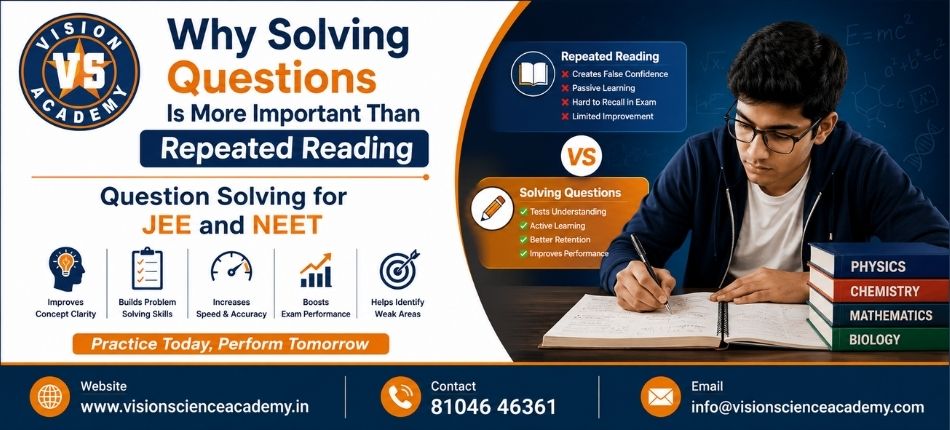
Why Solving Questions Is More Important Than Repeated Reading | Question Solving for JEE and NEET – Vision Academy
Preparing for competitive exams like JEE and NEET requires more than reading textbooks, notes, and formulas repeatedly. While reading is essential for understanding concepts, students also need to know whether they can recall and apply those concepts correctly when faced with an actual question.
This is where Question Solving for JEE and NEET becomes an important part of exam preparation. Regular question practice can help students assess their understanding, identify weak areas, improve speed and accuracy, and become more comfortable with different question patterns.
The goal is not to stop reading altogether. Instead, students should move from passive reading to a more active study cycle involving learning, solving, analysing, revising, and testing.
Why Repeated Reading Alone May Not Be Enough
When students read the same chapter several times, the information begins to look familiar. This familiarity can sometimes create the impression that the topic has been completely understood.
However, recognizing a formula or concept while looking at a textbook is different from recalling and applying it independently during an examination.
For example, a JEE aspirant may remember a Physics formula after reading it several times but may struggle to determine when and how to use it in a numerical problem. Similarly, a NEET aspirant may recognize a Biology statement in the textbook but become confused when similar-looking options appear in a multiple-choice question.
Question practice helps students check whether their knowledge can actually be applied.
Question Solving Improves Concept Clarity
One of the major advantages of Question Solving for JEE and NEET is that it helps students evaluate their conceptual understanding.
After completing a topic, solving questions based on it can reveal whether the concepts are genuinely clear. If a student repeatedly makes mistakes in questions based on a particular subtopic, it indicates that the concept may require additional revision.
Instead of repeatedly reading the entire chapter, students can then focus specifically on the areas where they are struggling. This makes revision more targeted and purposeful.
It Develops Application-Based Thinking
Competitive exams do not always ask questions exactly as concepts appear in textbooks. Students may need to interpret information, connect multiple concepts, eliminate incorrect options, or apply formulas in unfamiliar situations.
Regular question-solving trains students to identify what a question is actually testing.
For JEE aspirants, this may involve connecting multiple Physics or Mathematics concepts within a single problem. For NEET aspirants, it may involve distinguishing between closely related Biology statements or applying Chemistry concepts accurately.
The more varied questions students attempt, the more opportunities they get to develop application-based thinking.
Question Practice Strengthens Active Recall
Active recall involves retrieving information from memory without immediately referring to notes or textbooks.
When students attempt a question independently, they may need to remember a formula, reaction, definition, biological process, or problem-solving method. This retrieval makes studying more active.
Instead of reading the same formula repeatedly, students can try using it to solve different questions. If they cannot remember or apply it correctly, they know exactly what needs further revision.
Question Solving Identifies Weak Areas
Students cannot improve effectively unless they know where they are making mistakes.
Regular JEE and NEET question practice helps reveal weaknesses that repeated reading may not make obvious. A student might discover that they understand the theory but struggle with calculations, interpretation, time management, or particular types of questions.
Mistakes may result from:
- Weak conceptual understanding
- Incorrect formula selection
- Calculation errors
- Misreading the question
- Confusion between similar concepts
- Poor time management
- Guesswork
- Lack of practice with unfamiliar question types
Once the cause of a mistake is identified, students can take specific steps to correct it.
Question Solving Improves Speed and Accuracy
JEE and NEET are time-bound examinations. Knowing the answer is important, but students must also work efficiently.
Regular timed practice can help students become more familiar with solving questions within a limited period. Over time, they may become quicker at identifying relevant concepts, selecting an approach, performing calculations, and eliminating incorrect options.
Accuracy is equally important. Analysing incorrect answers can help students identify careless mistakes and develop better checking habits.
Therefore, effective Question Solving for JEE and NEET should focus on both speed and accuracy.
Students Become Familiar With Different Question Patterns
A single concept can be tested in several different ways.
If students only read theory and solved examples, they may become comfortable with familiar formats but struggle when the same concept appears in a different form.
Practising a variety of questions exposes students to different difficulty levels, wording styles, applications, and combinations of concepts.
This helps students develop flexibility in their problem-solving approach instead of depending entirely on memorized solutions.
Mistakes Become Part of the Learning Process
Getting a question wrong should not simply be treated as losing marks. It should be treated as feedback.
After every practice session, students should ask:
Why did I get this question wrong?
If the reason was a conceptual mistake, revise the concept. If it was a calculation mistake, work on calculation accuracy. If the question was misread, develop the habit of identifying important words before answering.
This process transforms mistakes into useful learning opportunities.
Maintain a Mistake Notebook
A mistake notebook can be particularly useful for JEE and NEET aspirants.
Students can record important incorrect questions along with the reason for the mistake and the correct approach. Instead of copying entire solutions, focus on what went wrong.
For example:
Question: Incorrect application of Newton’s second law
Mistake: Chose the wrong force direction
Correction: Draw a free-body diagram before writing equations
Action: Practice five similar questions
Over time, the notebook becomes a personalized revision resource containing the student’s actual weaknesses.
Question Practice Improves Time Management
Time management is difficult to learn from textbooks alone.
Timed question sets and mock tests help students understand how much time they spend on different types of questions. They can identify questions that consume too much time and learn when it may be better to temporarily move ahead.
Regular practice can also help students develop an exam strategy for balancing easier, moderate, and difficult questions.
Why Previous-Year Questions Are Important
Previous-year questions are an important part of Question Solving for JEE and NEET because they help students understand how concepts have been tested in actual examinations.
Students can use previous-year questions after completing the relevant concepts to evaluate their preparation.
However, they should avoid simply memorizing previous answers. Instead, analyse:
- Which concept is being tested?
- Why is the correct answer correct?
- Why are the other options incorrect?
- Is there another way to solve the question?
- Which part of the chapter should be revised?
This makes previous-year question practice much more valuable.
Don’t Ignore Correct Answers
Students naturally focus on questions they answered incorrectly, but correct answers should also be reviewed when necessary.
Sometimes a student gets the correct answer through guessing or an uncertain method. Such questions should be marked separately.
A correct answer is useful only when the student understands why it is correct.
A Smart Study Cycle for JEE and NEET
Students can follow this simple preparation cycle:
Learn → Solve → Analyse → Revise → Retest
First, understand the concept thoroughly. Then solve questions without constantly referring to notes. Analyse both incorrect and uncertain answers. Revise the weak concepts and attempt fresh questions to check whether the problem has been corrected.
Repeating this cycle can make preparation more active and focused.
Should Students Stop Reading?
No. Reading and question-solving serve different purposes.
Reading is essential when learning a new concept. Question-solving becomes important when students need to test whether they can remember and apply what they have learned.
A balanced approach could be:
Understand the Concept → Review Important Points → Solve Questions → Analyse Mistakes → Revise Weak Areas → Solve Again
Therefore, the message is not “Don’t read.” It is “Don’t depend only on repeated reading.”
How Vision Academy Helps Students Prepare Smarter
At Vision Academy, JEE and NEET preparation can focus on developing conceptual clarity along with regular question practice, test analysis, revision, and problem-solving skills.
Students benefit when they understand not only what to study but also how to evaluate their preparation. Regular practice can help them identify weaknesses early and work systematically toward improvement.
Conclusion
Understanding why solving questions is more important than repeated reading can significantly change the way students approach JEE and NEET preparation.
Repeated reading may make information familiar, but questions reveal whether students can actually recall, interpret, and apply that information.
Effective Question Solving for JEE and NEET helps students improve conceptual understanding, application skills, speed, accuracy, time management, and awareness of their weak areas.
The smarter approach is simple:
Read to Understand. Solve to Apply. Analyse to Improve. Revise to Strengthen.
Question Solving for JEE and NEET Question Solving for JEE and NEET Question Solving for JEE and NEET Question Solving for JEE and NEET Question Solving for JEE and NEET Question Solving for JEE and NEET Question Solving for JEE and NEET Question Solving for JEE and NEET Question Solving for JEE and NEET
 Previous Post
 Next Post