
How to Study NCERT Biology for NEET | Vision Academy
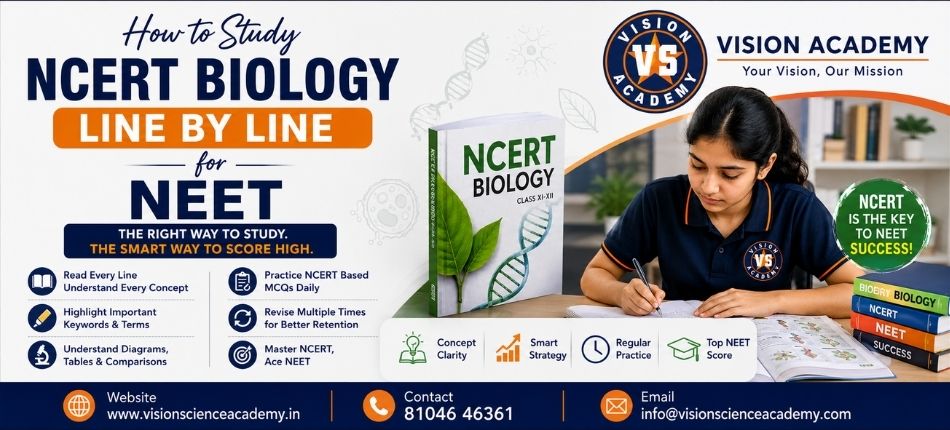
How to Study NCERT Biology Line by Line for NEET – Vision Academy
Biology is the highest-scoring subject in the NEET examination, contributing 360 out of 720 marks. Since a significant percentage of NEET Biology questions are directly based on the NCERT textbook, mastering every line of NCERT Biology is essential for securing a top rank. Many students read NCERT repeatedly but fail to retain concepts because they lack a structured study strategy.
At Vision Academy, we guide students with proven study techniques that help them understand, remember, and revise NCERT Biology effectively. Here’s a step-by-step guide to studying NCERT Biology line by line for NEET success.
Learn how to study NCERT Biology for NEET with expert tips, smart revision strategies, and MCQ practice from Vision Academy to score higher.
Why NCERT Biology is the Most Important Book for NEET
The National Testing Agency (NTA) frames a large portion of Biology questions directly from NCERT concepts. Even seemingly simple statements, diagrams, examples, and tables are frequently converted into objective questions.
Benefits of mastering NCERT Biology include:
- Strong conceptual understanding
- Better accuracy in NEET Biology
- Improved confidence during exams
- Faster revision before NEET
- Reduced dependency on multiple reference books
A thorough understanding of NCERT forms the foundation of excellent NEET preparation.
Read Every Chapter Slowly During the First Reading
During the first reading of an NCERT Biology chapter, focus on understanding rather than completing the chapter quickly. Read every paragraph carefully and pause whenever you encounter a new term, process, definition, or example. Try to understand how each statement connects with the previous and next concepts. Avoid memorising sentences mechanically at this stage. A slow and attentive first reading builds a strong conceptual foundation, making later revisions faster and helping you answer statement-based and application-oriented NEET questions accurately.
Highlight Important Keywords
NCERT Biology contains several keywords that can completely change the meaning of a statement. Terms such as “only,” “most,” “generally,” “except,” “always,” and “may” are especially important because NEET questions often test these small details. Highlight definitions, scientific names, examples, exceptions, hormones, enzymes, locations, functions, and numerical facts using a limited colour-coding system. Avoid highlighting entire paragraphs, as this reduces the usefulness of marking. During revision, the highlighted words should help you quickly recall the complete concept.
Understand Every Diagram Thoroughly
NCERT diagrams are an essential part of NEET Biology preparation and should never be treated as decorative illustrations. Carefully study every label, arrow, structure, sequence, and caption given with a diagram. Understand the function of each labelled part and its relationship with nearby structures. After studying the diagram, close the textbook and try to redraw or label it from memory. Students should also examine diagrams from both Class 11 and Class 12 NCERT books because questions may be asked directly from labels, structural differences, processes, or information mentioned in their captions.
Learn Tables and Comparisons Carefully
Tables and comparative information present multiple facts in a compact form, making them highly useful for NEET preparation. Study differences between similar concepts such as mitosis and meiosis, arteries and veins, DNA and RNA, monocots and dicots, or innate and acquired immunity. Instead of memorising isolated points, understand the basis of each comparison, including structure, function, location, and significance. Convert descriptive paragraphs into comparison tables wherever possible. Revising these tables regularly improves clarity and helps students eliminate confusing answer options during the examination.
Never Skip NCERT Examples and Facts
Examples, scientific names, special cases, and factual statements given in NCERT are frequently overlooked by students, but they can form the basis of direct NEET questions. Pay close attention to examples of plants, animals, diseases, hormones, enzymes, adaptations, organisms, and biological processes. Information written in brackets, captions, footnotes, or introductory paragraphs should also be studied carefully. Create a separate list of chapter-wise examples and exceptions, as these details are often difficult to remember and can help you score additional marks in fact-based questions.
Prepare Chapter-Wise Short Notes
After completing a chapter, prepare concise notes containing its most important information. Include definitions, keywords, diagrams, flowcharts, classifications, comparison tables, examples, exceptions, and frequently confused concepts. Short notes should not become a rewritten version of the entire textbook. Their purpose is to make revision faster and more focused. Use arrows, abbreviations, mind maps, and simple visual connections to organise information. Update these notes whenever you make mistakes in tests so that they gradually become a personalised revision resource for the final phase of NEET preparation.
Solve NCERT-Based MCQs Daily
Daily MCQ practice helps convert textbook knowledge into examination-ready understanding. After studying a topic, solve NCERT-based questions related to that topic and check whether you can identify the exact line or concept behind each answer. Do not focus only on the final score; analyse every incorrect and guessed response. Read all four options carefully and understand why the incorrect choices are wrong. Maintain an error notebook containing confusing facts and frequently repeated mistakes. Consistent MCQ practice improves accuracy, recall, time management, and confidence.
Revise Multiple Times
Biology involves a large amount of factual and conceptual information, so repeated revision is essential for long-term retention. Revise a newly studied topic within 24 hours, revisit it after a week, and review it again after a few weeks. Chapters containing classifications, examples, cycles, diagrams, and scientific terminology may require more frequent revision. Each revision should become quicker and more active. Instead of simply rereading, recall the content without looking, answer questions, label diagrams, and review highlighted lines. A planned revision cycle prevents forgetting and strengthens memory before the examination.
Practice Previous Years’ NEET Questions
Previous years’ NEET questions help students understand the level, language, and pattern of the examination. Solve chapter-wise previous questions after completing each topic and attempt full-length papers during the revision phase. For every question, locate the related concept in NCERT and study why the correct option is accurate. Also analyse the incorrect options because they may contain related facts that could appear in future questions. Regular PYQ practice reveals repeatedly tested areas, improves question interpretation, and teaches students how simple NCERT statements are converted into challenging objective questions.
Avoid Studying Multiple Biology Books
Using too many Biology books can create confusion, increase the study burden, and reduce the time available for NCERT revision. Students may encounter additional facts, different terminology, or unnecessary details that are not relevant to the NEET syllabus. Keep NCERT Biology as the primary resource and use coaching material or reference books mainly for MCQ practice and concept clarification. Complete every NCERT chapter thoroughly before consulting additional resources. Mastering one reliable source through repeated revision is generally more effective than reading several books without retaining their content.
Join Expert Guidance
Expert academic guidance can make NEET Biology preparation more structured, focused, and efficient. Experienced teachers help students understand difficult NCERT lines, identify important diagrams and examples, resolve conceptual doubts, and avoid common preparation mistakes. Regular tests, performance analysis, doubt-solving sessions, and personalised feedback also help students recognise weak chapters and improve consistently. At Vision Academy, students receive NCERT-focused teaching, systematic revision support, chapter-wise assessments, MCQ practice, and exam-oriented mentoring designed to strengthen their Biology preparation and improve their overall NEET performance.
Conclusion
Success in NEET Biology depends more on how well you study NCERT than how many books you read. Reading every line carefully, revising regularly, practicing MCQs, and analyzing previous years’ questions will significantly improve your Biology score. With the right guidance from Vision Academy, students can build confidence and maximize their NEET performance.
How to Study NCERT Biology for NEET How to Study NCERT Biology for NEET How to Study NCERT Biology for NEET How to Study NCERT Biology for NEET How to Study NCERT Biology for NEET How to Study NCERT Biology for NEET How to Study NCERT Biology for NEET How to Study NCERT Biology for NEET How to Study NCERT Biology for NEET How to Study NCERT Biology for NEET How to Study NCERT Biology for NEET How to Study NCERT Biology for NEET How to Study NCERT Biology for NEET
 Previous Post
 Next Post