
Physics Concepts for IIT JEE and NEET | Vision Academy
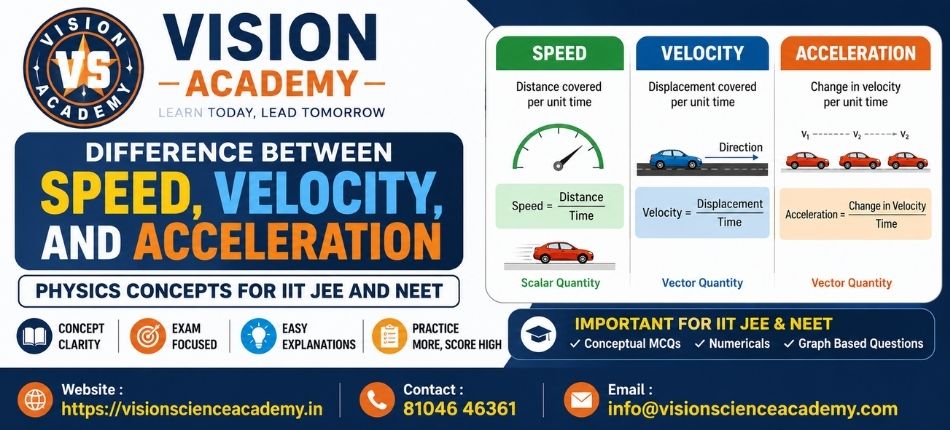
Difference Between Speed, Velocity, and Acceleration | Physics Concepts for IIT JEE and NEET – Vision Academy
Introduction
Physics is one of the most important subjects for students preparing for competitive exams like IIT JEE and NEET. Among the fundamental concepts in mechanics, understanding the Difference Between Speed, Velocity, and Acceleration is extremely important because these concepts form the base of motion and kinematics. Many numerical problems and conceptual questions in IIT JEE and NEET are directly based on these topics.
What is Speed?
Speed is a fundamental concept in physics that refers to the rate at which an object covers distance. It is defined as the total distance traveled by an object divided by the total time taken to travel that distance.
Mathematically, Speed = Distance / Time.
It is a scalar quantity, meaning it has only magnitude (a numerical value) and no direction. For example, if a car travels 100 kilometers in 2 hours, its speed is 50 km/h. Speed tells us “how fast” something is moving, but it doesn’t indicate the direction of motion (that’s what velocity does).
There are different types of speed: average speed (total distance over total time), instantaneous speed (speed at a specific moment), and uniform speed (when speed remains constant). Speed is measured in units like meters per second (m/s), kilometers per hour (km/h), or miles per hour (mph), depending on the context. It plays a crucial role in everyday life, from transportation and sports to understanding motion in science.
Types of Speed
1. Uniform Speed
When an object covers equal distances in equal intervals of time, it is said to move with uniform speed.
2. Non-Uniform Speed
When an object covers unequal distances in equal intervals of time, it is said to move with non-uniform speed.
3. Average Speed
Average speed is calculated by dividing total distance by total time taken.
\text{Average Speed} = \frac{\text{Total Distance}}{\text{Total Time}}
What is Velocity?
Velocity is a key concept in physics that describes the rate at which an object changes its position. It is defined as the displacement of an object divided by the time taken for that displacement.
Mathematically, Velocity = Displacement / Time.
Unlike speed, velocity is a vector quantity, which means it has both magnitude (how fast) and direction (in which way). For example, if a car is moving at 60 km/h towards the east, its velocity is 60 km/h east. The magnitude of velocity is actually the speed, but the inclusion of direction makes velocity more complete in describing motion.
There are two main types: average velocity (total displacement over total time) and instantaneous velocity (velocity at a particular instant). Velocity can be positive, negative, or zero depending on the direction of motion. It is measured in the same units as speed, such as meters per second (m/s) or kilometers per hour (km/h). Velocity is essential in physics because it helps us understand not just how fast something is moving, but also where it is heading, which is crucial in fields like mechanics, navigation, and engineering.
Important Points About Velocity
- Velocity includes direction.
- Change in direction changes velocity even if speed remains constant.
- Velocity can be positive, negative, or zero depending on displacement.
Uniform Velocity
An object is said to have uniform velocity if it moves in a straight line with constant speed and direction.
What is Acceleration?
Acceleration is the rate at which an object’s velocity changes over time. It tells us how quickly the speed or direction (or both) of an object is changing.
Mathematically, Acceleration = (Final Velocity – Initial Velocity) / Time or a = (v – u) / t.
Acceleration is a vector quantity, which means it has both magnitude and direction. If an object is speeding up, slowing down, or changing its direction, it is accelerating. For example, when a car increases its speed from 0 to 60 km/h in 5 seconds, it has an acceleration of 12 km/h per second (or 3.33 m/s²).
There are different types of acceleration:
- Uniform acceleration (constant acceleration)
- Non-uniform acceleration (changing acceleration)
- Positive acceleration (speeding up in the direction of motion)
- Negative acceleration (also called deceleration or retardation – slowing down)
The standard unit of acceleration is meters per second squared (m/s²).
In everyday life, acceleration is experienced when a vehicle starts moving, when you press the brakes, or during a roller coaster ride. It is a very important concept in physics because it helps explain how forces affect the motion of objects, as described by Newton’s Second Law of Motion (Force = Mass × Acceleration).
Types of Acceleration
1. Uniform Acceleration
When velocity changes equally in equal intervals of time.
2. Non-Uniform Acceleration
When velocity changes unequally in equal intervals of time.
3. Negative Acceleration
When the velocity decreases with time.
Difference Between Speed, Velocity, and Acceleration
| Basis | Speed | Velocity | Acceleration |
|---|---|---|---|
| Definition | Distance covered per unit time | Displacement covered per unit time | Change in velocity per unit time |
| Quantity Type | Scalar | Vector | Vector |
| Direction | Not required | Required | Required |
| Formula | Distance ÷ Time | Displacement ÷ Time | Change in Velocity ÷ Time |
| SI Unit | m/s | m/s | m/s² |
| Can be Negative? | No | Yes | Yes |
Real-Life Examples
Example of Speed
A bike moving at 60 km/h on a highway represents speed because only magnitude is considered.
Example of Velocity
A train moving at 80 km/h towards Mumbai represents velocity because direction is included.
Example of Acceleration
When a car increases its speed from 20 km/h to 50 km/h, it is accelerating.
Physics Concepts for IIT JEE and NEET Physics Concepts for IIT JEE and NEET Physics Concepts for IIT JEE and NEET Physics Concepts for IIT JEE and NEET Physics Concepts for IIT JEE and NEET Physics Concepts for IIT JEE and NEET Physics Concepts for IIT JEE and NEET Physics Concepts for IIT JEE and NEET Physics Concepts for IIT JEE and NEET Physics Concepts for IIT JEE and NEET Physics Concepts for IIT JEE and NEET Physics Concepts for IIT JEE and NEET Physics Concepts for IIT JEE and NEET
 Previous Post
 Next Post