
Newton’s Third Law of Motion | Science Academy in Kalyan
Newton’s Third Law of Motion -– Science Academy in Kalyan | Vision Academy
Newton’s Third Law of Motion is one of the most important concepts in physics and forms the foundation of mechanics and motion studies. This law explains how forces work in pairs and helps students understand many real-life movements and scientific applications. It is a crucial topic for school exams, board examinations, MHT-CET, JEE, NEET, and other competitive entrance exams.
At Vision Academy, a trusted Science Academy in Kalyan, students are taught physics concepts using practical examples, easy explanations, and conceptual learning methods that help improve understanding and problem-solving abilities.
What is Newton’s Third Law of Motion?
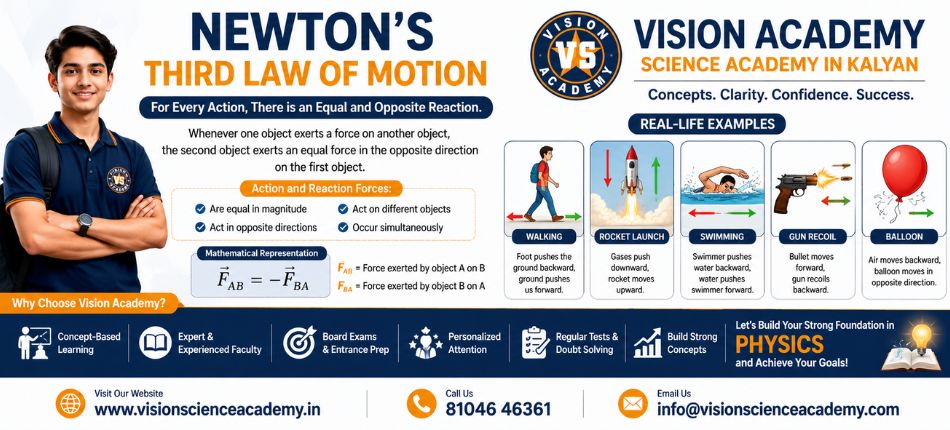
Newton’s Third Law of Motion states that:
For every action, there is an equal and opposite reaction.\text{For every action, there is an equal and opposite reaction.}
This means whenever one object applies a force on another object, the second object applies an equal force in the opposite direction on the first object.
The action and reaction forces:
- Are equal in magnitude
- Act in opposite directions
- Act on different objects
- Occur simultaneously
This law explains how objects interact with each other during motion and force application.
Understanding Action and Reaction Forces
Action and reaction forces are the pair of forces explained by Newton’s Third Law of Motion. Whenever one object applies a force on another object, the second object immediately applies an equal force in the opposite direction. These forces are called action and reaction forces. Both forces are equal in magnitude but act in opposite directions and on different objects. For example, while walking, our feet push the ground backward, and the ground pushes us forward with equal force, helping us move. Similarly, rockets move upward because gases are pushed downward with great force. Understanding action and reaction forces helps students clearly understand how motion occurs in daily life as well as in advanced scientific applications such as aviation, engineering, and space technology.
Real-Life Examples of Newton’s Third Law
Walking on the Ground
While walking, our feet push the ground backward. In response, the ground pushes us forward with equal force, helping us move ahead.
Rocket Launch
Rocket propulsion is one of the best examples of Newton’s Third Law. Hot gases are pushed downward from the rocket engine, and the rocket moves upward due to the equal and opposite reaction force.
Swimming
Swimmers push water backward using their hands and legs. The water then pushes the swimmer forward, helping them move through the pool.
Recoil of a Gun
When a bullet is fired forward from a gun, the gun experiences a backward force called recoil due to the opposite reaction force.
Balloon Releasing Air
When air escapes from an inflated balloon, the balloon moves in the opposite direction because of the reaction force created by escaping air.
Mathematical Representation of Newton’s Third Law
The law can be represented as:
F12=−F21F_{12} = -F_{21}
Where:
- F12F_{12} = Force exerted by object 1 on object 2
- F21F_{21} = Force exerted by object 2 on object 1
The negative sign indicates opposite direction.
Importance of Newton’s Third Law
Newton’s Third Law is extremely important in understanding:
- Motion of vehicles
- Flight of airplanes
- Rocket science
- Sports movements
- Mechanical systems
- Industrial machinery
It helps students understand force interaction and the principles behind motion and momentum.
Common Mistakes Students Make
Many students think action and reaction forces cancel each other. However, they act on different objects, so both forces can exist simultaneously without cancellation.
Another common mistake is misunderstanding the direction of forces. Students should carefully identify which object exerts the force and which object receives the reaction force.
Applications in Competitive Exams
Newton’s Laws of Motion are frequently asked in:
- CBSE Board Exams
- Maharashtra State Board Exams
- JEE Main & Advanced
- NEET
- MHT-CET
- Olympiads
Strong conceptual understanding helps students solve numerical problems and conceptual questions easily.
Why Choose Vision Academy – Science Academy in Kalyan?
Vision Academy is a trusted Science Academy in Kalyan known for providing quality education, conceptual learning, and result-oriented coaching for school students and competitive exam aspirants. Our experienced faculty members focus on simplifying difficult science concepts using practical examples, interactive teaching methods, and regular problem-solving practice. We provide personalized attention, structured study material, doubt-solving sessions, test series, and strong academic guidance for subjects like Physics, Chemistry, and Mathematics. Vision Academy also prepares students for board exams, MHT-CET, JEE, NEET, and other competitive examinations with a focus on conceptual clarity and confidence building. With modern teaching techniques, disciplined learning environments, and student-focused training, Vision Academy helps students achieve academic excellence and build a strong foundation in science subjects.
Conclusion
Newton’s Third Law of Motion is one of the fundamental laws of physics that explains force interactions and movement in daily life and advanced scientific applications. Understanding this concept clearly helps students improve their physics knowledge and perform better in competitive examinations.
If you are looking for expert science coaching and conceptual physics learning, Vision Academy – Science Academy in Kalyan provides professional guidance for academic and competitive exam success.
Newton’s Third Law of Motion Newton’s Third Law of Motion Newton’s Third Law of Motion Newton’s Third Law of Motion Newton’s Third Law of Motion Newton’s Third Law of Motion Newton’s Third Law of Motion
 Previous Post
 Next Post