
Chemical Reactions & Equations | Vision Academy
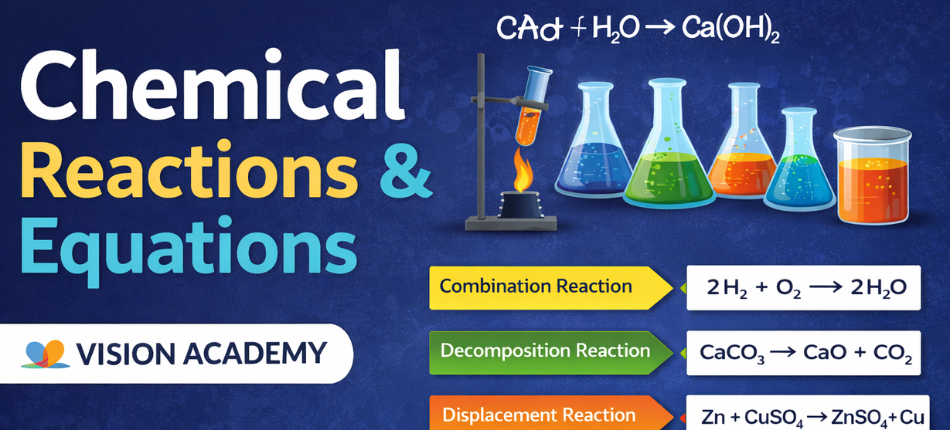
Chemical Reactions & Equations | IIT – JEE Coaching Classes in Kalyan – Vision Academy
Introduction
Chemical reactions and equations are one of the most important topics in science, especially for students preparing for board exams and competitive exams. At Vision Academy, we simplify complex concepts to help students understand and score better.
A chemical reaction is a process where one or more substances change into new substances with different properties.
Learn chemical reactions & equations easily with examples, types, and balancing methods. Complete guide for students by Vision Academy.
What is a Chemical Reaction?
A chemical reaction involves the transformation of reactants into products. During this process, bonds between atoms break and new bonds are formed.
📌 Example:
Hydrogen + Oxygen → Water
2H₂ + O₂ → 2H₂O
What is a Chemical Equation?
A chemical equation is a symbolic representation of a chemical reaction using chemical formulas.
Types of Chemical Equations:
- Word Equation (Hydrogen + Oxygen → Water)
- Skeletal Equation (H₂ + O₂ → H₂O)
- Balanced Equation (2H₂ + O₂ → 2H₂O)
Law of Conservation of Mass
The Law of Conservation of Mass states that mass can neither be created nor destroyed during a chemical reaction. This means that the total mass of all substances before a reaction (reactants) is always equal to the total mass of substances after the reaction (products). In a chemical process, atoms are simply rearranged to form new substances, but their number and mass remain unchanged. For example, when hydrogen reacts with oxygen to form water, the combined mass of hydrogen and oxygen before the reaction is exactly the same as the mass of water produced. This law is fundamental in chemistry and is the reason why chemical equations must be balanced to accurately represent reactions.
Types of Chemical Reactions
1. Combination Reaction
A combination reaction is a type of chemical reaction in which two or more substances combine to form a single product. In this reaction, simpler substances join together to create a more complex compound. These reactions usually release energy in the form of heat or light (exothermic). For example, when calcium oxide reacts with water, it forms calcium hydroxide. Combination reactions are commonly seen in processes like burning, rusting, and formation of compounds.
2. Decomposition Reaction
A decomposition reaction is the opposite of a combination reaction, where a single compound breaks down into two or more simpler substances. These reactions generally require energy in the form of heat, light, or electricity (endothermic). For instance, when calcium carbonate is heated, it decomposes into calcium oxide and carbon dioxide. Decomposition reactions are important in industrial processes and laboratory experiments.
3. Displacement Reaction
A displacement reaction occurs when a more reactive element replaces a less reactive element from its compound. This type of reaction depends on the reactivity of elements, which is determined by the reactivity series. For example, when zinc is added to copper sulfate solution, zinc displaces copper and forms zinc sulfate. These reactions are commonly used in metal extraction and chemical manufacturing.
4. Double Displacement Reaction
A double displacement reaction involves the exchange of ions between two compounds to form two new compounds. These reactions usually occur in aqueous solutions and often result in the formation of a precipitate, gas, or water. For example, when sodium sulfate reacts with barium chloride, barium sulfate (a precipitate) and sodium chloride are formed. Double displacement reactions are widely used in chemical analysis and purification processes.
How to Balance Chemical Equations?
- Write the skeletal equation
- List atoms on both sides
- Balance one element at a time
- Check and simplify coefficients
Conclusion
Chemical reactions and equations form the backbone of chemistry. With proper understanding and practice, students can master this topic easily.
Chemical Reactions & Equations Chemical Reactions & Equations Chemical Reactions & Equations Chemical Reactions & Equations Chemical Reactions & Equations Chemical Reactions & Equations Chemical Reactions & Equations Chemical Reactions & Equations Chemical Reactions & Equations Chemical Reactions & Equations
 Previous Post
 Next Post